Motta St. Anastasia German military cemetery, War cemetery in Motta Sant'Anastasia, Italy.
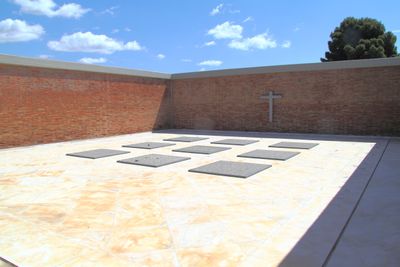
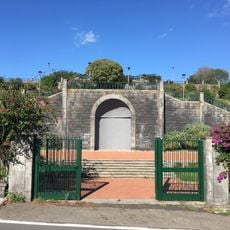
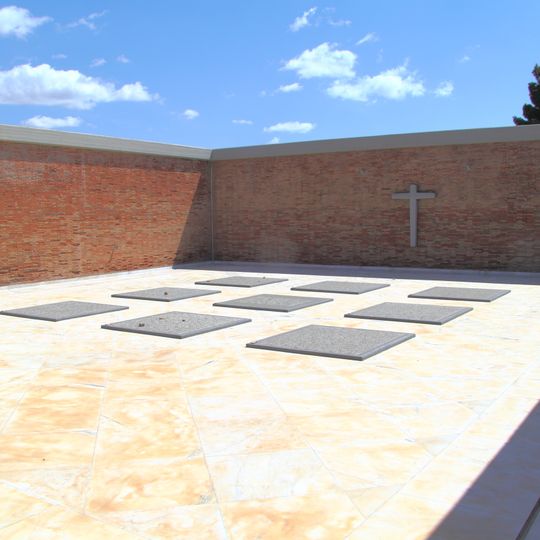
Motta St. Anastasia German military cemetery is a war cemetery at the foot of Mount Etna, on the edge of the SP13 road between Motta Sant'Anastasia and Misterbianco. It was designed by the Göttingen architect Diez Brandi and inaugurated on 25 September 1965. The entrance is a travertine-paved forecourt with a stele; a staircase leads to the elevated Kameradengrab courtyard, which holds a bronze statue of a dying youth on a pedestal. Four further courtyards, enclosed by walls of Roman brickwork, are named after Sicilian provinces and carry the names of the dead on 52 natural-stone plaques; the 4,561 dead lie in a walled, inaccessible crypt below.
The cemetery was established in 1965 as a memorial site for German soldiers who died during the 1943 Sicily campaign. It was created after the war ended to honor those lost in the fighting.
The cemetery organizes fallen soldiers by Sicilian provinces, with dedicated courtyards for Palermo, Caltanissetta, Messina, and Catania regions reflecting local geographical connections.
The cemetery is accessible from the parking area via marked paths that guide you through the grounds. An information center on site allows visitors to look up details about those buried there.
The Kameradengrab courtyard is not a mass grave: a central plaque names 28 known and three unknown soldiers buried there, and eight further stone slabs list 128 German soldiers who died in Sicily between 1941 and 1943. A bronze statue of a dying youth stands on a pedestal in the middle of the courtyard.
The community of curious travelers
AroundUs brings together thousands of curated places, local tips, and hidden gems, enriched daily by 93,465 contributors worldwide.