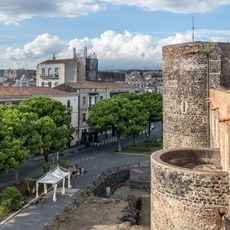
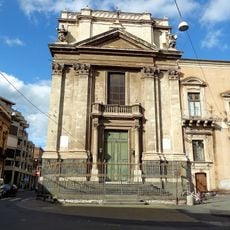
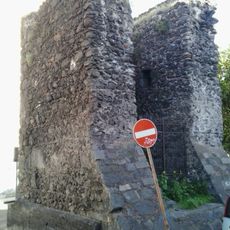
Campanarazzu, Archaeological site in Misterbianco, Italy.
Campanarazzu is the buried site of the old town of Misterbianco, about 3 km north-east of today's centre. The 1669 Etna lava flow covered the settlement, and almost nothing of it remains visible. Excavations begun in 2009 uncovered the roofless church "matrice", whose roof and doors were later rebuilt with modern materials to shelter it.
The original settlement of Misterbianco stood at this location until Mount Etna erupted in March 1669, covering the entire town in lava. This sudden burial preserved the structures and objects beneath the volcanic rock, allowing researchers today to study how people lived in medieval Sicily.
The name Campanarazzu comes from the bell of the Monasterium album, the white monastery whose religious confraternity founded the settlement around 1300. A bell survived the 1669 eruption and was hung on an olive tree where the lava flow stopped, a spot called "Aliva m'pittata" (Ulivo pettoruto).
The site opened to the public on 21 February 2025; visits generally take place on Sundays from 10:00 to 12:00, though opening arrangements remain uncertain, so check locally before going. A walkway is installed inside the excavated rooms to ease visitor flow. A few hundred metres away, a small park with children's games and a grove growing over the old rocks is open permanently, within set hours.
The name Campanarazzu comes from the bell of the Monasterium album, the white monastery whose religious confraternity founded the settlement around 1300. A bell survived the 1669 eruption: because the lava flow stopped at that point, it was hung on a sturdy olive tree halfway between Misterbianco and the ruined town, and the spot was called "Aliva m'pittata" (Ulivo pettoruto).
The community of curious travelers
AroundUs brings together thousands of curated places, local tips, and hidden gems, enriched daily by 94,468 contributors worldwide.