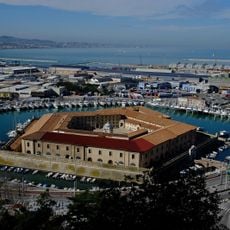
Cittadella di Ancona, Renaissance fortress on Colle Astagno, Italy.
Cittadella di Ancona is a five-sided fortress built on a hilltop overlooking the city. It was constructed with several bastions positioned to provide views across the harbor and surrounding lands.
Pope Clement VII commissioned the fortress in 1533, as recorded on the inscription above the entrance, with Cardinal Benedetto Accolti as legate. Antonio da Sangallo the Younger designed it as part of the same papal programme that produced the Fortezza da Basso in Florence and Rocca Paolina in Perugia. The Bastione Gregoriano was rebuilt under Gregory XVI after Austrian troops demolished much of it in the Napoleonic era; the work, by engineer Provinciali, ended in 1841.
Locals of the Capodimonte district still call the fortress "Casematte", a name used by young people in the city. The five bastions carry names tied to their history: Gregoriano from Pope Gregory XVI, who rebuilt it by 1841, and Punta, called Barberino in the 17th century after Pope Urban VIII. The double salient with a twin embrasure on the Campana bastion is the model Sangallo devised for this "bell" type.
Access to the site is by walking up hillside paths, and the interior can be explored on foot across various levels and bastions. Wear sturdy shoes since the ground is uneven and there are steep stairs in some areas.
The fortress is still known locally as "Casematte", a name used by young people in Ancona. The entrance on the Guardia bastion was once reached by a drawbridge; the holes for its chains and the hinge housings are still visible in the masonry. Above the gate, a 1533 plaque names Pope Clement VII and Cardinal Benedetto Accolti.
The community of curious travelers
AroundUs brings together thousands of curated places, local tips, and hidden gems, enriched daily by 92,894 contributors worldwide.