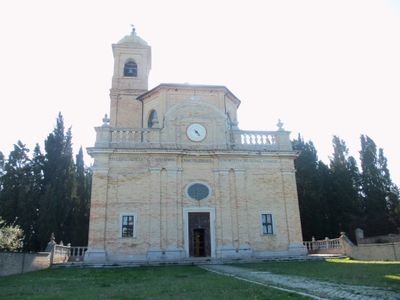
Eremo di Monte Giove, Camaldolese hermitage in Fano, Italy.
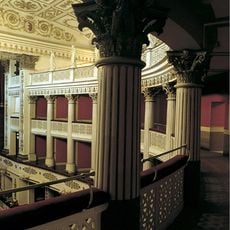
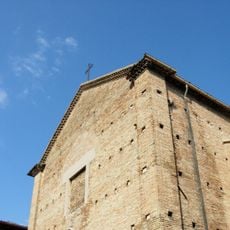
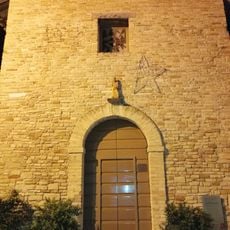
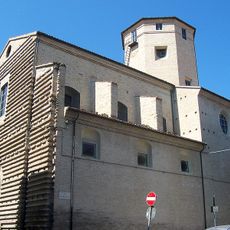
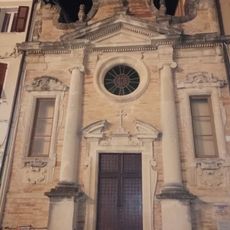
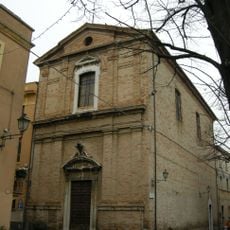
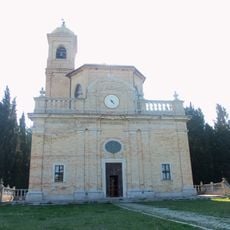
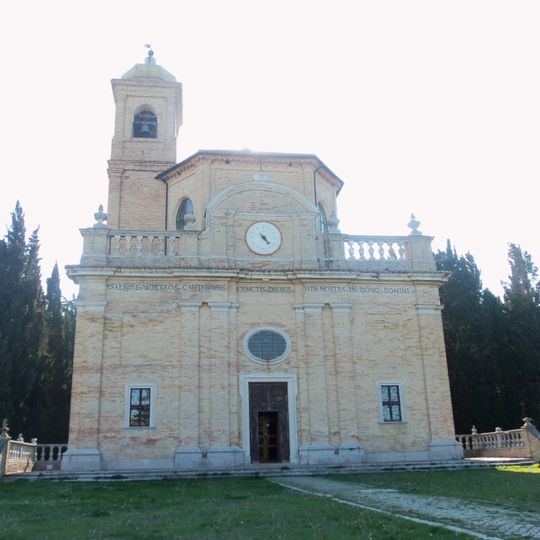
The Eremo di Monte Giove stands at 223 metres above sea level on the highest of the hills ringing Fano. Its church, dedicated to the Saviour, has a tripartite facade and an octagonal interior opening on one side into a deep choir. Around it lie the monks' small houses with their vegetable plots and a guesthouse, across about three and a half hectares.
Camaldolese monks of the Benedictine order acquired the hilltop in 1609 and built their convent there, completed in 1627 with contributions from benefactors and the commune of Fano, which supplied grain. The first church, consecrated in 1631 by Cardinal Giulio Sacchetti, had a single nave with four side chapels. In 1741, after ground subsidence, it was rebuilt further back to a design by the Rimini architect Giovan Francesco Buonamici.
The church is dedicated to the Saviour and holds stucco statues of Saint Benedict, Saint Scholastica, Saint Peter Damian and Saint Boniface by the Rimini sculptor Carlo Santi; the Saint Romuald is by the Venetian Antonio Corradini. In the presbytery hangs Giovanni Andrea Lazzarini's Transfiguration above the wooden choir, and the sacristy keeps his Madonna with saints and the archangel Gabriel. Two canvases come from the earlier 17th-century church: the Saint Romuald and the miracle of the beech, now attributed to Gian Domenico Cerrini (1655–1656), and a Christ Child with the cross, Saint Joseph and saints, assigned to Venanzio da Camerino.
The hermitage sits on the highest of the hills around Fano, at 223 metres above sea level; the climb is rewarded by a view over the city, the coast and, up the Metauro valley, the Apennines dominated by Monte Catria. The complex covers about three and a half hectares, with monks' cottages, their vegetable plots and a guesthouse with rooms. Because it is a secluded place, it is often used for spiritual retreats and study meetings, so check availability before planning a group visit.
The hilltop became Camaldolese property in 1609, when the monks began their convent, finished in 1627 with funds from benefactors and the commune of Fano, which supplied the community with a large quantity of grain. The church was consecrated in 1631 by Cardinal Giulio Sacchetti.
The community of curious travelers
AroundUs brings together thousands of curated places, local tips, and hidden gems, enriched daily by 92,787 contributors worldwide.