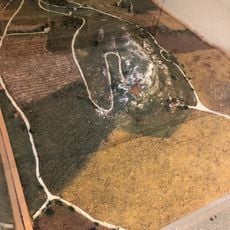
Grotte della Gurfa, Archaeological site in Alia, Italy.
Grotte della Gurfa is a rock-cut complex near Alia, in the province of Palermo, made of six chambers hewn by hand into a yellowish sandstone cliff, with no natural cavities used. On the lower level a rectangular room measures 9.59 by 9.15 m under a two-sloped ceiling once called "a saracina", beside a bell-shaped hall 16.35 m high with an elliptical plan of 14.10 by 11.59 m and a 0.70 m oculus at the top. A rock-cut stair leads to four roughly square upper rooms, each with a wide window onto the valley.
The caves are man-made, cut into yellowish sandstone without using natural cavities; dating is uncertain, ranging from 2500–1600 BC to late Roman or Byzantine times. At a 2009 CNR study day in Palermo, scholars proposed the bell-shaped hall (16.35 m high) began as a grain pit, later enlarged with wooden lofts into a hayloft used until the 1950s. In 1995 Benedetto Rocco read the two ground-floor chambers as a Mycenaean-type monumental tomb of about 1500 BC.
Local stories connect this place to ancient Greek tales, suggesting it may have been a burial site for King Minos who pursued the craftsman Daedalus to Sicily. These legends continue to shape how visitors understand the location today.
Access to the caves is possible, though sturdy footwear is recommended since the ground is uneven and can be slippery in places. Bring a flashlight to explore darker corners more effectively.
The bell-shaped chamber, 16.35 m high with an elliptical plan of 14.10 by 11.59 m and a 0.70 m oculus at the top, was likened to the tholos of Atreus at Mycenae, leading one scholar to propose the complex was cut to hold the remains of King Minos. In 1995 Giuseppe Tornatore filmed scenes of L'uomo delle stelle here.
The community of curious travelers
AroundUs brings together thousands of curated places, local tips, and hidden gems, enriched daily by 93,902 contributors worldwide.