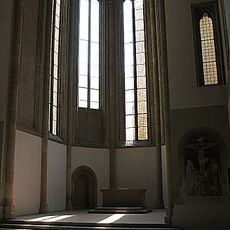
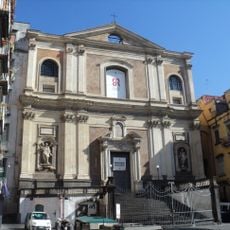
Ladislao di Durazzo's tomb, Marble funeral monument in San Giovanni a Carbonara, Italy
Ladislao di Durazzo's tomb is an 18-metre late-Gothic marble monument set in the apse of San Giovanni a Carbonara in Naples, behind the high altar. It is divided into four horizontal registers and five vertical bands, the central one about twice the width of the others, with the outer bands against the apse walls. Four cardinal virtues — Temperance, Fortitude, Prudence and Magnanimity — stand as caryatids on the base, and the top register carries an equestrian statue of the king in armour with drawn sword.
Giovanna II d'Angiò commissioned the tomb in 1414, the year her brother King Ladislao died, to honour the whole d'Angiò-Durazzo dynasty; work continued until about 1428. It is attributed by tradition to Andrea da Firenze, who was then active in San Giovanni a Carbonara. A contract of 12 January 1428 in Lucca engaged sculptor Giovanni di Gante and collaborators to finish the missing sculptures.
The four cardinal virtues on the base — Temperance, Fortitude, Prudence and Magnanimity — stand as caryatids supporting the upper tiers. In the second register, Ladislaus and Joanna II sit enthroned among Hope, Justice, Charity and Faith, while the side niches hold two 1428 frescoes by Leonardo da Besozzo: John the Baptist and Augustine of Hippo.
The tomb can be viewed during the church's opening hours, typically from Monday through Saturday, allowing time to examine the fine marble details. The church is easily reached on foot and the surrounding historic center is manageable and straightforward to navigate.
The equestrian statue of Ladislaus at the very top wears armour and holds a drawn sword, and beneath it reads the inscription "Divus Ladislaus". The horse itself points to Lombard Gothic models, a northern element in a Neapolitan tomb.
The community of curious travelers
AroundUs brings together thousands of curated places, local tips, and hidden gems, enriched daily by 93,459 contributors worldwide.