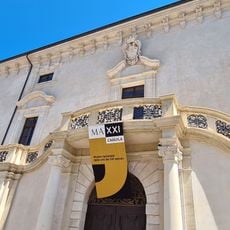
Palazzo Ardinghelli, Baroque palace and contemporary art museum in L'Aquila, Italy.
Palazzo Ardinghelli is a Baroque palace on Piazza Santa Maria Paganica in L'Aquila, facing the side of the church of Santa Maria Paganica. It has two main levels plus a partial basement. A triple balcony from 1928 marks the entrance, leading through a paved hall to a small exedra courtyard with a portico, from which a monumental Borrominian staircase with marmorino walls and five paintings attributed to Vincenzo Damini (1744) rises.
Palazzo Ardinghelli rose on Renaissance remains of the Cappa and Camponeschi families. Filippo and Francesco Ardinghelli commissioned the Roman architect Francesco Fontana, son of Carlo, in the early 18th century, but construction ran only from 1732 to 1743. With Filippo's death the family died out before completion, and the palace passed to the Cappelli family.
The palace has housed MAXXI L'Aquila, a branch of Rome's National Museum of 21st Century Arts, since its inauguration on 28 May 2021. The name Ardinghelli comes from the Tuscan family whose ancestor Andrea settled in L'Aquila in the 16th century; locals also call the building Palazzo Franchi Cappelli. In 2014 the local rugby team wore an event jersey publicising the restoration.
The palace faces the side wall of the church of Santa Maria Paganica on the square of the same name, in the Santa Maria quarter. The entrance is marked by a triple balcony of 1928 above a portal aligned with the church's side door; from the paved androne a small exedra courtyard leads to the monumental staircase.
After the 2009 earthquake, the Russian government supported the restoration with substantial funding. This enabled workers to discover valuable paintings that had been hidden within the walls.
The community of curious travelers
AroundUs brings together thousands of curated places, local tips, and hidden gems, enriched daily by 94,674 contributors worldwide.