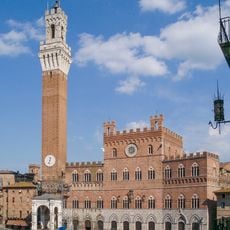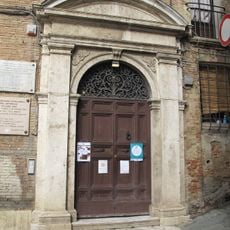
Palazzo Piccolomini, Renaissance palace in central Siena, Italy.
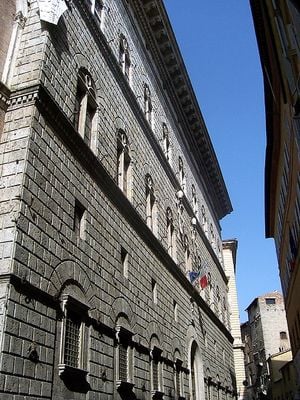
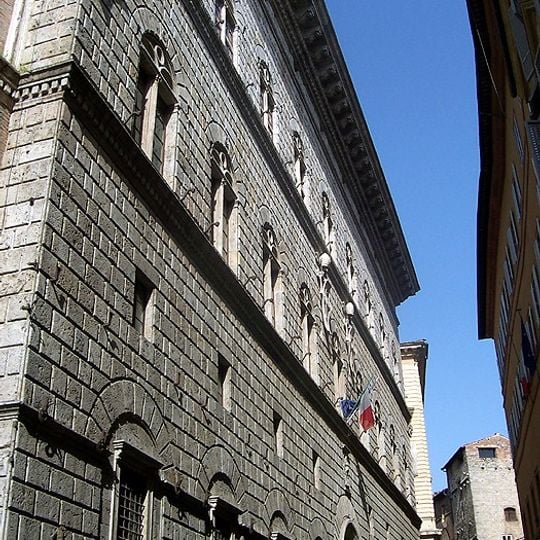
Palazzo Piccolomini stands on Banchi di Sotto at the corner of Via Rinaldini, its tall facade of rough dark grey stone blocks rising to a projecting stone cornice. Rows of arched windows with carved stone surrounds are divided by a string-course band, and a green, white and red flag hangs near the lower right. The ground-floor windows are framed in worked travertine, the rest of the facade in cavernous limestone.
Construction began in 1469 to designs by Bernardo Rossellino for the Piccolomini family, who were relatives of Pope Pius II. Pietro Paolo Porrina later continued the work and helped shape the building into one of the key examples of Sienese Renaissance design.
The palace houses the State Archives of Siena and the museum of the Biccherna tablets, painted wooden covers of the city's medieval account books. The crescent moons carved here and there on the facade allude to the Piccolomini coat of arms.
The palace houses the State Archive of Siena and a collection of painted wooden tablets depicting scenes from the city's history. Some areas may have access restrictions, so it is worth checking conditions before you visit.
The archive inside the palace holds Giovanni Boccaccio's will and the original contract for the Fonte Gaia fountain by Jacopo della Quercia. These documents are not always on public display, but they make this one of the most unusual archives in Italy.
The community of curious travelers
AroundUs brings together thousands of curated places, local tips, and hidden gems, enriched daily by 94,180 contributors worldwide.