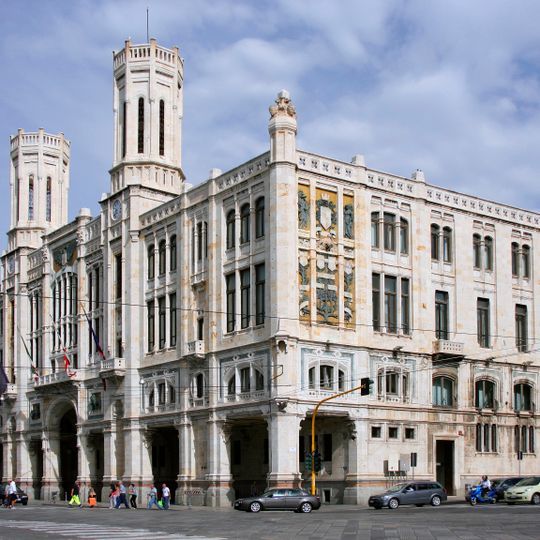
Palazzo Civico, Gothic Revival palace in Cagliari, Italy.
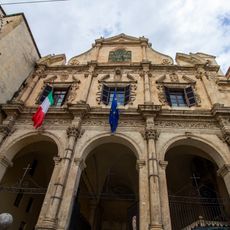
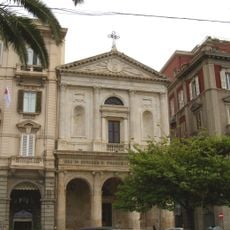
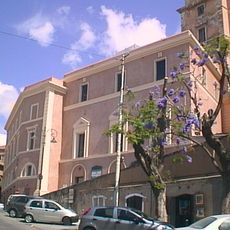
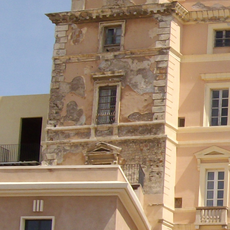
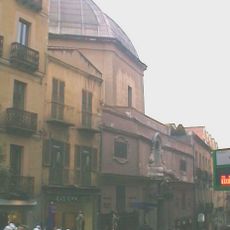
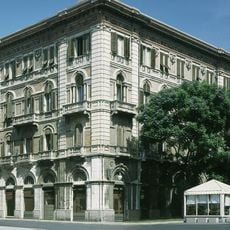
Palazzo Civico is built of Pietra Forte, a light limestone, not sandstone. Its main facade on Via Roma has a seven-arch portico with a central arch nine metres high leading to the courtyard. Two octagonal towers rise 38 metres above the facade, and four obelisks at the corners carry sculpted heads of the four Moors.
Architect Crescentino Caselli designed this building, which opened in 1907 as Cagliari's administrative center. It was built during a period when the city was modernizing and constructing new public structures to reflect its growing importance.
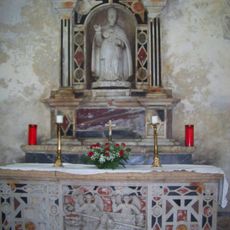
The council chamber holds three large canvases by Filippo Figari painted between 1916 and 1924, showing the vicar of Pisa with the archbishop of Cagliari, Victor Amadeus II of Savoy and a group of kneeling Moors. In the adjoining Sala della Giunta hangs the retablo dei Consiglieri, a 16th-century work by Pietro Cavaro. A 17th-century clay figure of Saint Augustine lying down is carried in procession on 28 August to the nearby church of the Marina.
The main entrance opens onto Via Roma through a nine-metre central arch, with the arcade aligned to the porticoes along the street. The building is bounded by Largo Carlo Felice, Via Crispi and Via Angioi, a short walk from the port. Look up at the facade for the two octagonal towers, 38 metres tall, and the four obelisks at the corners.
The council chamber holds three large canvases by Filippo Figari painted between 1916 and 1924, showing the vicar of Pisa with the archbishop of Cagliari, Victor Amadeus II of Savoy, and a group of kneeling Moors. The adjoining Sala della Giunta keeps the retablo dei Consiglieri, a 16th-century work by Pietro Cavaro.
The community of curious travelers
AroundUs brings together thousands of curated places, local tips, and hidden gems, enriched daily by 92,788 contributors worldwide.