Palais de Philippe d'Anjou, Medieval royal palace in Naples, Italy.
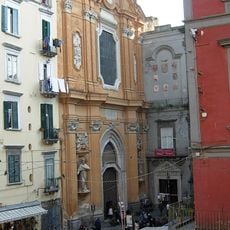
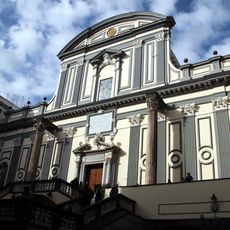
Palais de Philippe d'Anjou, also called Palazzo Filippo d'Angiò, is a noble palace in Naples' San Lorenzo district, considered the city's oldest palace. Filippo I d'Angiò, prince of Taranto and emperor of Constantinople, merged and partly rebuilt earlier structures into a series of Gothic porticoes. The Cicinelli family later restored it with round arches and Baroque window decoration; the portico structure and the central portal survive, with a 14th-century fresco of the Virgin Mary above on the left.
The palace was built in Gothic forms as the residence of Philip I of Anjou, prince of Taranto and emperor of Constantinople, who merged and partly rebuilt several earlier structures, adding a series of Gothic porticoes. It later passed to the Cicinelli family, princes of Tursi, who restored it with round arches and Baroque decoration, visible in the windows. Under Alfonso V of Aragon its porticoes housed the newly founded Accademia Pontaniana, called Porticus Antonianus because Antonio Beccadelli, known as il Panormita, presided over its meetings.
The palace's name recalls Filippo I d'Angiò, prince of Taranto and emperor of Constantinople, who built it in Gothic forms. Under Alfonso V of Aragon its porticoes housed the Porticus Antonianus, the first seat of the Accademia Pontaniana, presided over by Antonio Beccadelli, known as il Panormita. A 14th-century fresco of the Virgin Mary survives high on the left, and the courtyard holds a marble relief with the family coat of arms, a duck and three lilies.
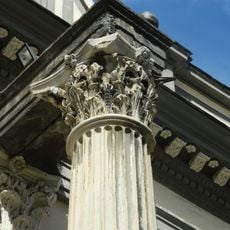
The palace stands in the San Lorenzo district, near Via dei Tribunali and a short walk from Palazzo d'Avalos, whose arcades look similar. The ground-floor portico is occupied by a neighbourhood market, so the pillars and courtyard are best seen when the stalls are less crowded. The piperno pillars are held by a metal cage after damage from later baroque additions.
The palace stands at a location that witnessed multiple European power shifts, showing how rapidly control of Naples' most important buildings could pass between competing dynasties. This change of rule is reflected in both the building's design choices and the surrounding area.
The community of curious travelers
AroundUs brings together thousands of curated places, local tips, and hidden gems, enriched daily by 92,797 contributors worldwide.