Porta Santa Maria, Renaissance city gate in Lucca, Italy
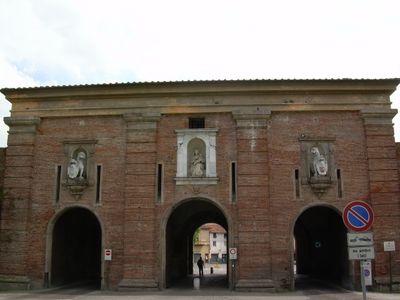
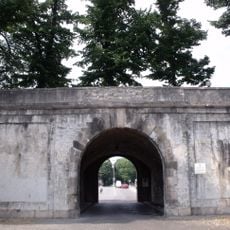
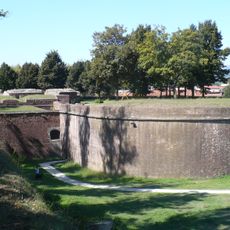
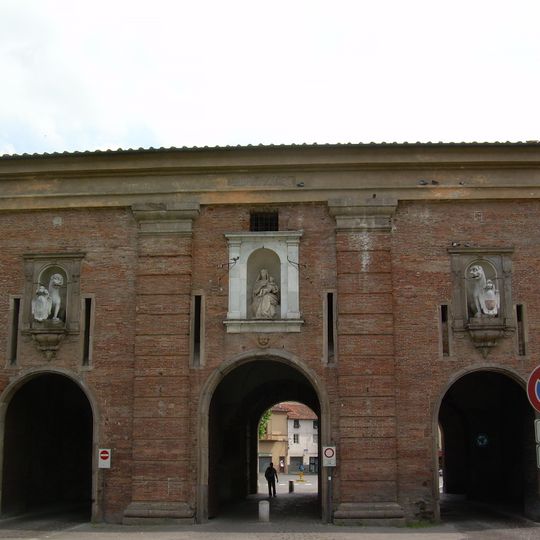
Porta Santa Maria is the northern entrance gate featuring a central archway for pedestrians and two side passages designed for vehicle traffic through the city walls. The entire structure connects the entry point directly to the historic city center and the elevated walkway running along the fortification walls.
Porta Santa Maria was built between 1549 and 1592 as part of Lucca's Renaissance walls. It was designed by architect Ginese Bresciani and constructed by Michelangelo Gabrielli. The gate was dedicated to the Virgin Mary, whose marble statue stands in a niche on the outer facade. Originally it had a single opening; the two side passages were added later, each topped by a statue of a panther, the symbol of Lucca.
The gate displays marble sculptures of panthers, which represent Lucca, and holds frescoes showing the Annunciation with the Archangel Gabriel and the Madonna on opposite walls. These artworks reflect the religious and political identity that the city held during the Renaissance period.
The gate provides direct access to the historic center and the elevated walkway along the city walls with views of the surrounding architecture. Visitors should note that the wall walkway can become slippery in wet conditions, so sturdy footwear is recommended.
On the inner facade, a marble bas-relief of Saint Peter carries the word 'Libertas' beneath it, the motto of the Republic of Lucca. The gate also served as the terminus of the Lucca-Ponte a Moriano tramway from 1883; in 1884 the line was extended so trams could pass through the gate to the new Porta San Pietro terminus, and it closed in 1932.
The community of curious travelers
AroundUs brings together thousands of curated places, local tips, and hidden gems, enriched daily by 93,037 contributors worldwide.