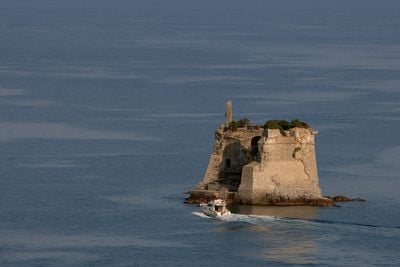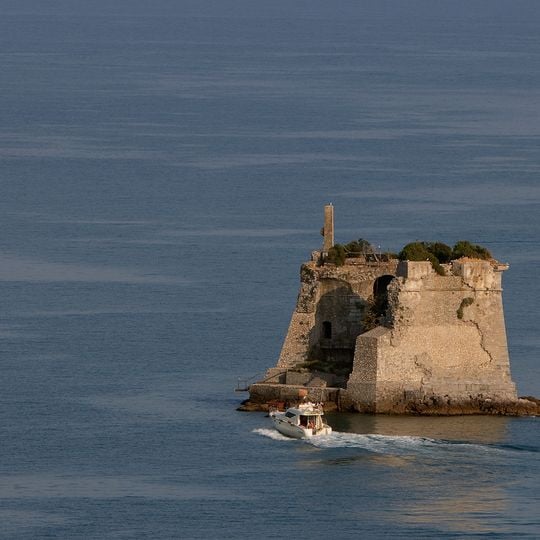
Scola Tower, Sea fort in Porto Venere, Italy.
Scola Tower, also called the tower of St. John the Baptist, stands on a rock just off the northeastern tip of Palmaria Island. It has a pentagonal plan with walls about four metres thick, reinforced inside by tall buttresses. A steep flight of steps cut in the rock still leads up from the shore to the entrance, and five small lookout turrets once stood at the corners of the walkway.
Genoa's Senate built the tower in 1606 on the rock off Punta Scola, at an estimated cost of 56,000 Genoese liras, as part of its coastal defence system. On 23 January 1800 a naval engagement between British and French fleets left one wall breached; the tower was abandoned for much of the 19th century. Scheduled for demolition in 1915, it was saved by Ubaldo Mazzini and converted into a signal lighthouse, then restored between 1976 and 1980.
The tower's other name, Tower of St. John the Baptist, comes from the dedication carved on a marble plaque above the entrance, naming Geronimo Asereto and dated 1606; a second plaque inside, under the flooring, names Giulio Rapallo and the year 1608. A 1773 report records that access from the rock ran up a steep flight of steps, still present, to a portal bearing the Genoese insignia, now destroyed.
The tower is reachable only by boat from Porto Venere, with tours offered primarily during summer months. Visitors should book in advance and watch weather conditions, as rough seas can affect the trips.
The fortress was originally designed for just eight soldiers and ten cannons, a surprisingly small garrison for such a solid structure. Despite its modest scale, it played an important role in the defensive system against attackers.
The community of curious travelers
AroundUs brings together thousands of curated places, local tips, and hidden gems, enriched daily by 93,126 contributors worldwide.