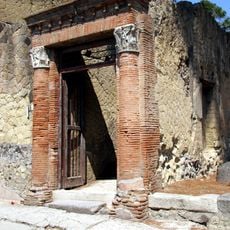
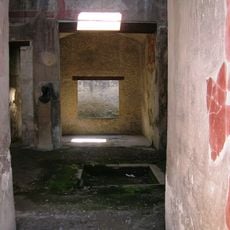
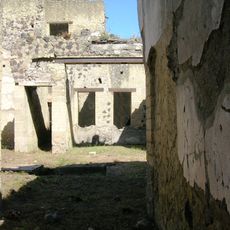
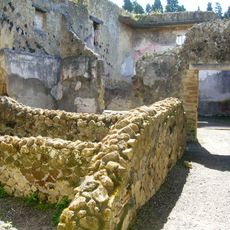
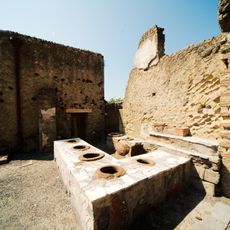
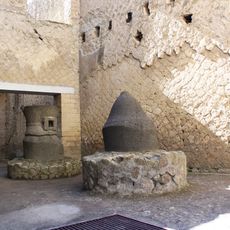
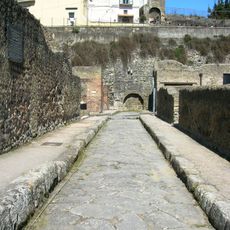
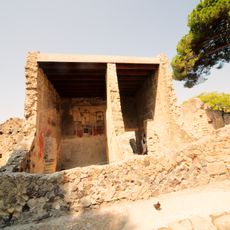
House of the Deer, Herculaneum, Roman residential structure in Ercolano, Italy
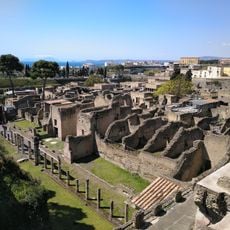
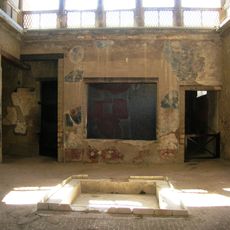
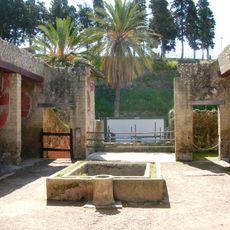
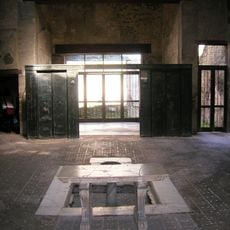
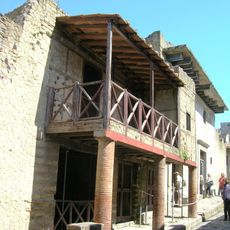
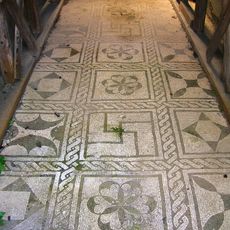
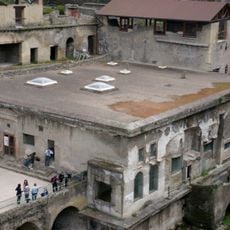
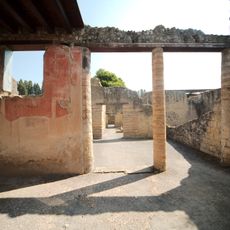
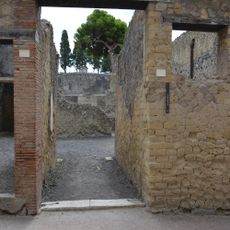
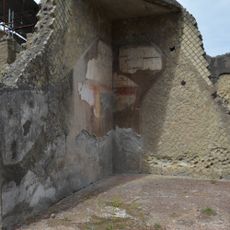
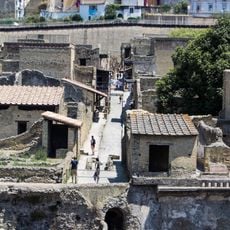
The House of the Deer is a Roman residential building in Herculaneum with a peristyle surrounding a central garden and multiple rooms strategically arranged around this inner courtyard. The spaces are decorated with wall paintings and house marble sculptures, while a terrace offers views toward the Bay of Naples.
The house was built during Emperor Claudius's reign and belonged to Celer, a freed slave of Quintus Granius Verus, as confirmed by stamped bread discovered inside. It was buried by the eruption of Mount Vesuvius in 79 AD and has since remained a significant record of Roman domestic architecture.
The house takes its name from two marble deer attacked by dogs found in the garden, alongside a satyr with a wineskin and a drunken Hercules. The cryptoporticus walls carry sixty painted panels of still lifes, cupids and architectural motifs; some were removed under the Bourbons and are now in the National Archaeological Museum of Naples.
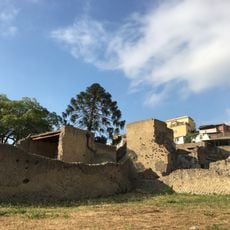
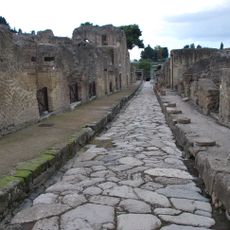
The house is located within the Herculaneum archaeological site and can be visited on established pathways, with most areas reasonably accessible for viewing. Visitors should wear comfortable shoes and prepare for temperature variations depending on the season, and bring water for extended exploration.
The cryptoporticus was painted with sixty panels of still lifes, cupids and architectural motifs; some were removed during the Bourbon explorations and are now in the National Archaeological Museum of Naples. The garden walls facing it carry a large portal whose pediment has a glass-paste mosaic of Oceanus surrounded by cupids riding sea creatures.
The community of curious travelers
AroundUs brings together thousands of curated places, local tips, and hidden gems, enriched daily by 92,883 contributors worldwide.