Ipogeo, Underground tunnel network beneath Piazza Duomo in Syracuse, Italy.
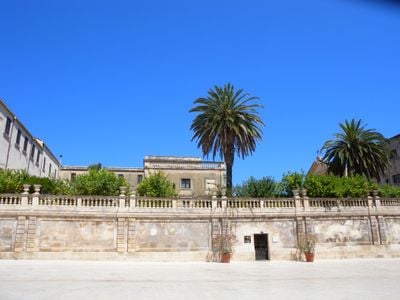
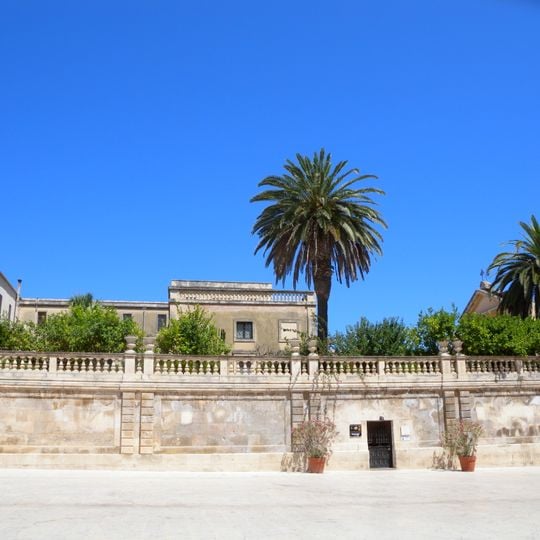
The Ipogeo is an underground route beneath Syracuse that runs from Piazza del Duomo, the highest point of Ortigia, to the Marina walls near the Foro Italico. It consists of a main gallery with smaller branches; one branch links to a cistern in the courtyard of the Palazzo Arcivescovile. A rectangular black metal gate with vertical bars, set in a light stone wall topped by a balustrade, marks an entrance.
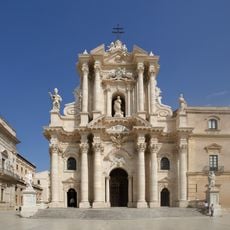
The tunnels began as a quarry from which the pietra siracusana used to build Syracuse Cathedral was cut. Bishop Paolo Faraone (1619–1629) had a cistern in the Archbishop's Palace courtyard linked to the galleries to supply water to the palace and Ortigia. During World War II residents sheltered here from air raids; reopened in 2006 after restoration, the site was reopened on 16 July 2014 with exhibitions curated by the CNR.
The name ipogeo refers to the underground galleries beneath Piazza Duomo. The site displays photographs taken inside the shelter during the World War II bombings, and since 2014 it has hosted exhibitions curated by the CNR.
Visitors should wear sturdy shoes since the ground is uneven and passages can be narrow in places. Guided tours are regularly available and help explain the history and different functions of the complex.
The tunnel system connects to large water cisterns that once supplied the entire Ortigia district. This demonstrates the advanced water management technology that the ancient city had developed.
The community of curious travelers
AroundUs brings together thousands of curated places, local tips, and hidden gems, enriched daily by 93,238 contributors worldwide.