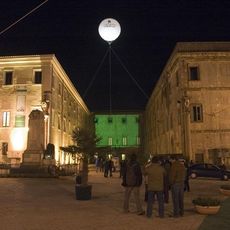
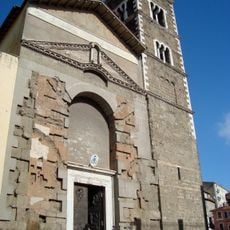
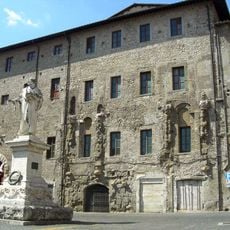
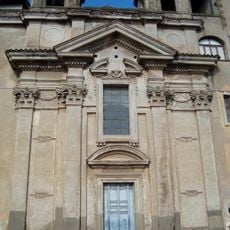
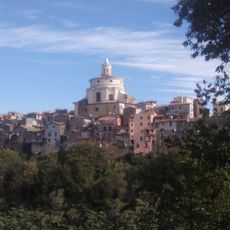
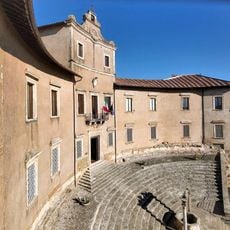
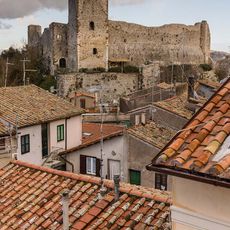
Palazzo Doria-Pamphilj, Baroque palace and museum in Valmontone, Italy.
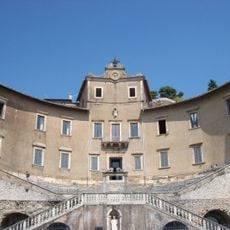
Palazzo Doria-Pamphilj is a massive, square baroque palace in Valmontone, divided into 365 rooms. Its Piano Nobile holds frescoes painted between 1657 and 1661 by artists such as Pier Francesco Mola, Gaspard Dughet, Guillaume Courtois, Francesco Cozza and Mattia Preti. The ground floor houses the Museo di Palazzo Doria-Pamphilj, with finds from local archaeological sites.
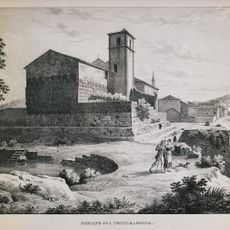
The building began as a fortified castle, renewed and enlarged by the Barberini in the first half of the 17th century. When Prince Camillo Pamphilj obtained the Valmontone fief in 1651 he made it the centre of his Città Panfilia, an ideal town with church, stables, warehouses and houses. The main construction phase, supervised by the Jesuit father Benedetto Molli, ran from about 1653 to 1658, with later changes up to the 18th century. On 25 May 1944 bombing badly damaged the palace.
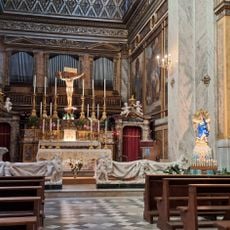
The name joins the Doria and Pamphilj families; Camillo Pamphilj, who obtained the Valmontone fief in 1651, named his ideal town Città Panfilia. The private chapels are dedicated to God the Father ("del Padreterno") and to Saint Agnes, patron saint of the Pamphilj. The frescoes were painted between 1657 and 1661 by artists including Pier Francesco Mola, Gaspard Dughet, Guillaume Courtois and Mattia Preti.
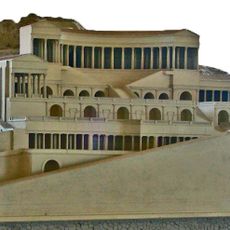
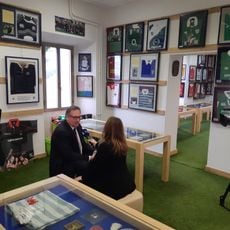
The archaeological museum occupies four rooms on the palace's ground floor, so the frescoed Piano Nobile above is a separate visit. The exhibits reconstruct sites around Valmontone, including the charcoal burners' village of Colle Carbone, the farm settlement of Colle dei Lepri, the Roman baths by the statio and the kiln of Colle Pelliccione. Look for the leather pectoral with gold leaf, the museum's symbol, and the tuff sarcophagus of the 3rd century AD found in 2011 near the airfield.
The main floor contains four specially designed rooms symbolizing Fire, Air, Water, and Earth as distinct spaces. Additionally, several chambers throughout the palace are dedicated to different continents, reflecting how the family wanted to express their vision of the world.
The community of curious travelers
AroundUs brings together thousands of curated places, local tips, and hidden gems, enriched daily by 93,026 contributors worldwide.