Villa Etelinda, 19th century villa in Bordighera, Italy
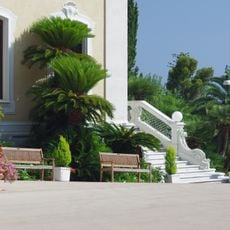
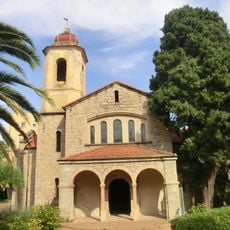
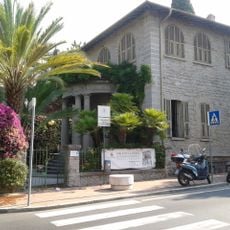
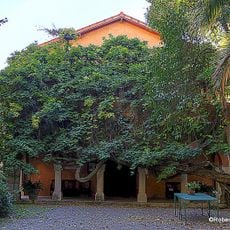
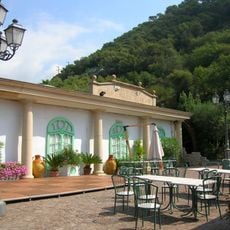
Villa Etelinda is a 19th-century mansion on Via Romana in Bordighera, recognizable by its slender tower decorated with geometric mosaics and arched openings. The facade features detailed leaf patterns along its archways, and the building now houses a private art collection.
Raphaël Bischoffsheim, a Paris-based banker of German origin, commissioned Charles Garnier in 1873 to build the villa, completed in 1875. Cost cuts shrank Garnier's ambitious first design. A dispute over a loan for upgrading Via Romana, settled in favour of Garnier's plan in June 1877, and the city's rejection of his Montenero observatory project led Bischoffsheim to fund the Nice observatory in 1878.
The villa was renamed in 1896 to honour the opera Etelinda by Mildred Marion Bowes-Lyon, daughter of the owner Claude Bowes-Lyon. She was one of the first women to have her own opera staged, and her name was revealed only on the second night. The RB monogram of Raphaël Bischoffsheim remains between the arches of the entrance loggia.
The building is easy to spot from Via Romana, and visits inside are available through guided tours. It is worth checking in advance whether tours are running, as opening times can be limited.
The painter Claude Monet depicted the villa in his 1884 canvas Les Villas à Bordighera, now held at the Musée d'Orsay in Paris. The slender tower and the polychrome mosaics of the facade, recalling Moorish decoration, are the elements Garnier kept from his first, larger design.
The community of curious travelers
AroundUs brings together thousands of curated places, local tips, and hidden gems, enriched daily by 95,284 contributors worldwide.