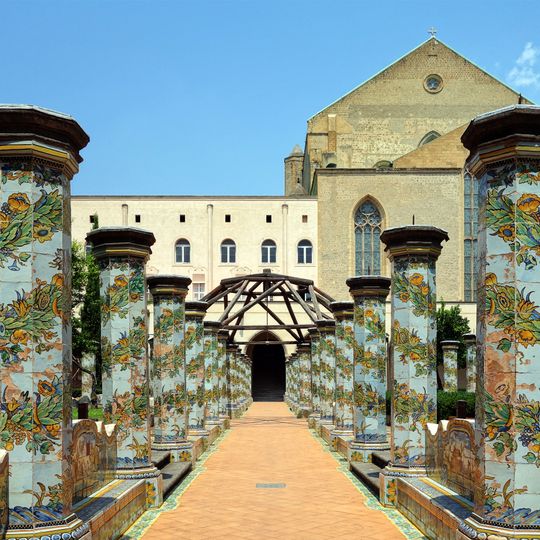
Cloître des Clarisses de Santa Chiara, Franciscan cloister in Naples, Italy.
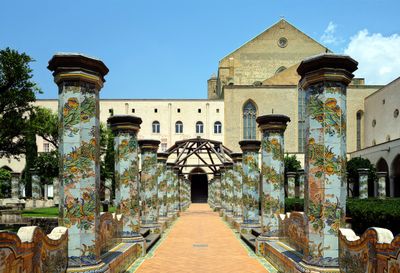
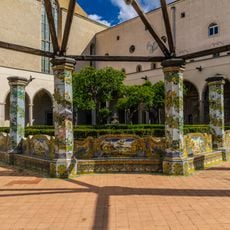
The Chiostro maiolicato is the large cloister of the Santa Chiara monastery in Naples, measuring 82.3 by 78.3 metres. Its portico has 72 octagonal pillars with pointed arches and cross vaults, and two raised crossing paths lined with 64 majolica-clad pillars and benches. The tiles by Donato and Giuseppe Massa show flowers, fruit, landscapes and scenes of 17th- and 18th-century Naples.
The cloister was created in 1739 by Domenico Antonio Vaccaro, who kept the Gothic pillars and pointed arches of the great cloister but redesigned the rustic garden. The majolica tiles are by Donato and Giuseppe Massa, and the work was funded by aristocratic donations and pushed by abbess Ippolita di Carmignano, who also sought help from Queen Maria Amalia of Saxony. The 1943 air raid spared the cloister while damaging much of the basilica.
The tiles are the work of Donato and Giuseppe Massa, who painted landscapes, rural scenes, masks and mythological subjects, plus scenes of daily life in 17th- and 18th-century Naples showing what went on outside the walls. The two crossing avenues are lined with tiled benches and columns, and the garden is divided into four quarters alluding to earth, air, fire and water.
The cloister lies in the historic centre of Naples, entered from the Santa Chiara monastery complex; the garden is crossed by two raised avenues in a cross, reached by steps, so the tiled walkways are not step-free. The 64 majolica pillars and the benches along the avenues are best examined in the morning light, before the site fills with groups.
The garden's raised walkways are lined with 64 octagonal majolica pillars, and the benches and columns carry scenes of daily Neapolitan life in the 17th and 18th centuries, showing the city outside the walls and allegories of the four elements: earth, air, fire and water.
The community of curious travelers
AroundUs brings together thousands of curated places, local tips, and hidden gems, enriched daily by 94,365 contributors worldwide.