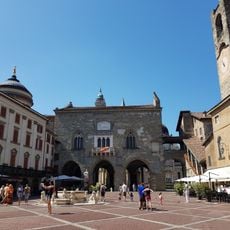
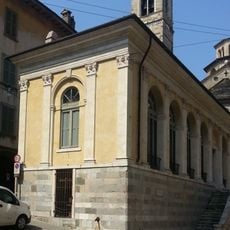
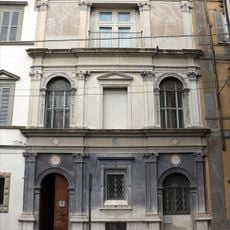
Palazzo Medolago, Neoclassical palace in Upper Town, Bergamo, Italy
Palazzo Medolago Albani stands on Viale delle Mura near Porta San Giacomo in Bergamo. Its upper facade has a carved under-eaves with false beams, topped by a decoration centred on a clock space flanked by four statues by Antonio Gelpi representing Architecture, Sculpture, Painting and Poetry. The entrance atrium, courtyard and staircase are attributed to Leopoldo Pollack.
Simone Cantoni designed the palace from 1770 for an aristocratic clientele; in 1841 it was bought by Count Giacomo Medolago Albani, who had it transformed and embellished into one of the city's most distinguished residences. Under him it hosted Emperor Franz Joseph I of Austria with his wife Elisabeth of Bavaria and King Vittorio Emanuele II of Italy, visits recorded on stone plaques at the entrance.
The palace rooms carry the names of their decoration: the Galleria del Bonomini holds frescoes by Paolo Vincenzo Bonomini (1757–1839), and the Sala Rossa has the Medolago, Zanchi, Grumelli and Colleoni coats of arms in its ceiling corners. In a stuccoed hall by Atanasio Soldati hang seven landscapes by Luigi Deleidi, known as Il Nebbia.
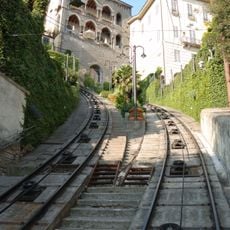
The palace stands on Viale delle Mura beside Porta San Giacomo, on the edge of Bergamo's Upper Town. The building is not open to the public, so it is seen from the street; the entrance plaques and the facade are visible from the pavement. The Upper Town is reached from the lower city by funicular or bus, then on foot along the walls.
The five marble medallions between the floors were created in 1848 by sculptor Giovanni Maria Benzoni and depict scenes from a classical Italian epic poem. This artistic decoration was a display of the count's wealth and refined taste at the time.
The community of curious travelers
AroundUs brings together thousands of curated places, local tips, and hidden gems, enriched daily by 94,238 contributors worldwide.