Santa Maria del Rosario Church, Religious building in Via Solari, Milan, Italy.
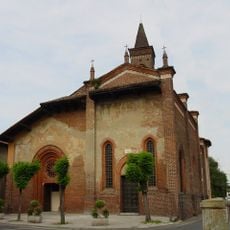
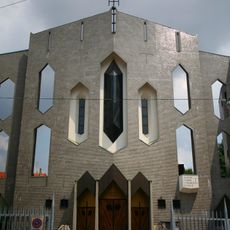
Santa Maria del Rosario is a parish church completed in 1914 to a design by the priest-architect Enrico Locatelli. Its red-brick facade has a gabled roofline divided by pilasters, with three doors for the three naves; the central door has a porch topped by a lunette mosaic of the Virgin of the Rosary, added in 1977 to a design by Gian Luigi Uboldi. A tall stained-glass window by Luigi Vianello runs across the facade, ending in a Gothic arch where the medieval-style rose window stood until 1952. The conical-spired bell tower, begun in 1921 by Spirito Maria Chiappetta, stands slightly apart along the left buttress.
The church was completed in 1914 to a design by the priest-architect Enrico Locatelli, replacing a small concrete chapel erected in 1907 for the new residents of the Via Solari district. That neighbourhood had grown rapidly after the 1905 construction of the Società Umanitaria's first popular housing quarter by Giovanni Broglio, which housed a thousand people by 1906. The bell tower, designed by Spirito Maria Chiappetta, was begun in 1921 and finished in 1924.
The parish is named after the Rosary, and its central portal carries a mosaic of Santa Maria del Rosario made in 1977 to a design by painter and woodcut artist Gian Luigi Uboldi, with the side lunettes done at the same time by the Sgorlon firm. The parish cultural centre is named after Walter Tobagi, a regular churchgoer assassinated by the Red Brigades in nearby via Salaino on 28 May 1980; his funeral was held here on 30 May, celebrated by Cardinal Martini.
The church stands on Piazza del Rosario, along Via Andrea Solari, in the San Siro-Sempione-Vercellina deanery, a short walk from the Porta Genova station area. The bell tower rises slightly detached from the building along the left buttress, so it is visible before the facade. The five bells were removed on 5 May 2016 for maintenance on the bell frame and returned on 24 June of the same year.
The five bells in the campanile, cast by the Ottolina firm of Seregno, were removed on 5 May 2016 because the bell frame showed signs of settling, and returned on 24 June of the same year. The bell tower itself was begun in 1921 to a design by Monsignor Spirito Maria Chiappetta and completed in 1924 under engineer Giuseppe Calori.
The community of curious travelers
AroundUs brings together thousands of curated places, local tips, and hidden gems, enriched daily by 93,364 contributors worldwide.