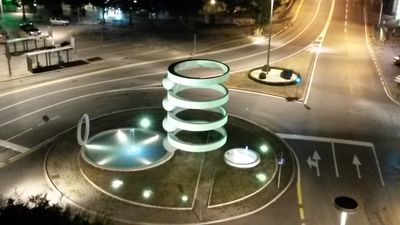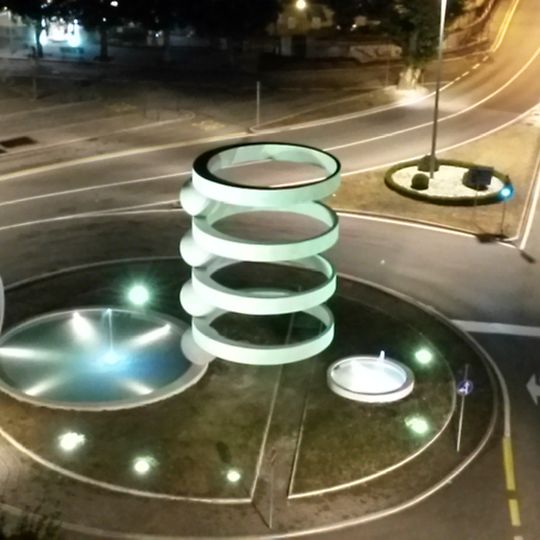
Camerlata fountain, Concrete fountain in Camerlata district, Como, Italy.
The Camerlata fountain is a white concrete structure made of a circular base platform and four thick open rings stacked vertically with gaps between them, forming a spiral. Two shallow circular basins sit on the base beside the ring stack. It was designed as an abstract work expressing ordered movement at the traffic junction where it stands.
The fountain was commissioned by Como's podestà Attilio Terragni and made in 1935–1936 by Cesare Cattaneo and Mario Radice for the VI Triennale di Milano, where it was shown in Parco Sempione. Dismantled and stored during World War II, it was rebuilt in Como and placed in its current spot in 1964.
The fountain's name comes from Piazzale Camerlata, the square where it stands. A widespread local belief holds that the stacked rings represent Alessandro Volta's electric battery, but the work is abstract and was meant to convey ordered movement at a traffic junction. Proposals to move it to Piazza Cavour were repeatedly rejected.
The fountain stands at a major traffic intersection in the Camerlata district and is easily accessible by car or public transportation from Como's center. The location offers good visibility from the street, so it remains noticeable even during a brief stop.
The architect's son, Damiano Cattaneo, described this work as a monument to traffic, designed specifically to be perceived from moving vehicles. This conception unites art form with the rhythm of urban life in an unusual way.
The community of curious travelers
AroundUs brings together thousands of curated places, local tips, and hidden gems, enriched daily by 94,669 contributors worldwide.