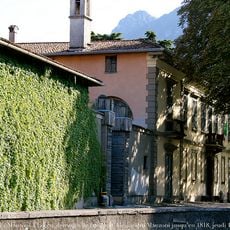
City walls of Lecco, Medieval fortification in Lecco, Italy.
The city walls of Lecco were a triangular perimeter fortification built from 1336 by Azzone Visconti, with the base along the lake at today's molo and the apex at Porta Nuova on Via Bovara. The lower part of the torrione survives as the base of the San Nicolò bell tower, and the sagrato of the basilica rests on part of the old walls.
Construction of the walls began in 1336 under Azzone Visconti's rule to protect the growing settlement. In the 16th century they were reinforced during Spanish control, until Austrian authorities ordered their demolition in 1782 as the city transitioned to an open town.
The walls' triangular plan is still legible in Lecco's street pattern: the base ran along today's molo at Porta di Santo Stefano, one side climbed to the torrione beneath the campanile of San Nicolò, and the apex was Porta Nuova on Via Bovara. The Spanish governors' palace now houses the civic library, and the sagrato of the basilica rests on part of the old walls.
The best places to see the walls are the streets around the old town, particularly along Via Bovara where sections are most visible. Walking at a leisurely pace allows you to observe the different parts and notice how they connect to nearby landmarks.
The round bastion the Spanish built as a cannon platform was reused at the end of the 19th century as the base for the bell tower of San Nicolò; part of the old walls still supports the basilica's forecourt, and the palace of the Spanish governors now houses the civic library.
The community of curious travelers
AroundUs brings together thousands of curated places, local tips, and hidden gems, enriched daily by 94,633 contributors worldwide.