Farnese room, Renaissance ceremonial room in Palazzo d'Accursio, Bologna, Italy
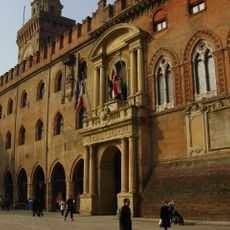
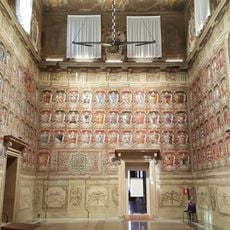
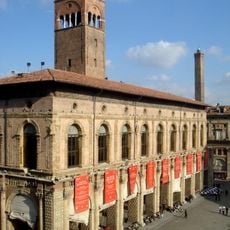
The Farnese Room is a hall on the second floor of Palazzo d'Accursio, built in the 1430s together with the Sala d'Ercole below it. It measures 34.69 metres long and 11.22 metres wide and served as a vestibule to the Cappella Farnese and the legate's apartment. Its walls carry eight frescoes of Bologna's history, coordinated by Carlo Cignani and inaugurated in 1661.
Built in the 1430s together with the Sala d'Ercole below, the room served as a vestibule to the Cappella Farnese and the legate's apartment. After Charles V was crowned King of Italy on 22 February 1530 in the adjoining chapel, it was called Sala Regia. Its present name comes from a statue of Paul III Farnese destroyed in 1796 by Napoleonic troops; Cardinal Girolamo Farnese commissioned the frescoes, inaugurated in 1661.
The eight wall frescoes, coordinated by Carlo Cignani and inaugurated in 1661 under Cardinal Girolamo Farnese, depict key episodes of Bologna's history rather than mythological scenes. They include San Petronio granting the Theodosian privilege, Francis I healing scrofula patients in 1515, and the coronation of Charles V. The privilege fresco refers to a document later shown to be a 13th-century forgery.
The room is on the second floor of Palazzo d'Accursio, reached via the palazzo's museum route; the entrance to the Cappella Farnese opens in the middle of the right-hand wall as you enter. The eight frescoes are read starting from the right on entering and continuing up the left wall from the far end back toward the entrance, so follow that order to see them in sequence.
Each wall section tells its own story, yet connected architectural elements create visual continuity throughout the entire space. This painting technique makes the boundaries between reality and artwork seem to dissolve.
The community of curious travelers
AroundUs brings together thousands of curated places, local tips, and hidden gems, enriched daily by 94,670 contributors worldwide.