Eremo di Poggio Conte, Gothic hermitage in Ischia di Castro, Italy
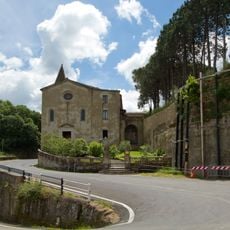
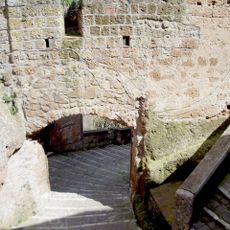
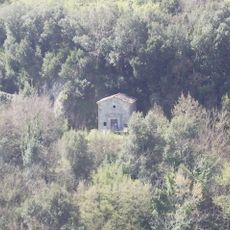
Eremo di Poggio Conte, also called Romitorio di San Colombano, is carved into volcanic tuff on the border between Lazio and Tuscany. A steep staircase cut into the rock leads to two small caves, possibly enlarged Etruscan chamber tombs, with rock-cut shelves and a flue. Adjacent is a Gothic-Cistercian church with two square rooms: an entrance hall with a dome on four clustered pillars and a rear room with a cross vault and a straight-ended apse holding three seats.
The hermitage is first mentioned in a 1027 donation charter, though the church's architecture and frescoes date to the 12th and 13th centuries. Some historians link it to the Templar Order, which had stations along the Via Clodia; after the order was suppressed by Pope Clement V in 1312, the site may have been taken from the Templars. The thirteen niches for apostle panels were cut later, damaging part of the original vault fresco.
The reversed triangle carved on the left column's capital, repeated outside the adjacent dwelling, is a Templar symbol for the number three. The dome's floral design and the cross vault's paired paintings—phalli and rhomboid shapes—are read as male and female symbolism. Six surviving tuff panels of the apostles, attributed to a 12th- or 13th-century Lazio master, are now in Ischia di Castro's civic museum.
The hermitage is reached on foot along a dirt path that follows the Fiora River through dense vegetation; a steep staircase cut into the volcanic rock wall then leads up to the two caves and the church. Sturdy shoes are needed, and the caves have little interior space.
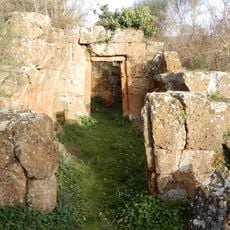
Near the cliffs, Etruscan chamber tombs are carved into the stone, which monks later converted for their meditation chambers. These burial sites show how the ground was seen as holy across many centuries.
The community of curious travelers
AroundUs brings together thousands of curated places, local tips, and hidden gems, enriched daily by 94,195 contributors worldwide.