Aosta Town Hall, Historic town hall in Aosta, Italy.
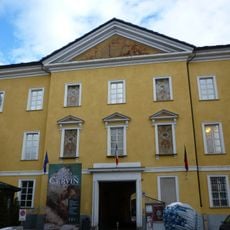
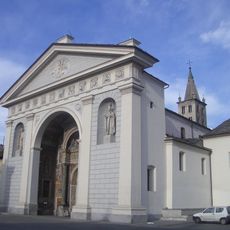
Aosta Town Hall is a neoclassical building on Piazza Émile Chanoux, erected between 1835 and 1841 to designs by architect Michelangelo Bossi. Its symmetrical facade is crowned at the centre by a large, richly decorated pediment, and a portico runs along the ground floor. At the base of the portico stand two sculptures representing the Dora Baltea and the Buthier, the two rivers that skirt the city.
A Franciscan convent, the couvent des Cordeliers, stood on this site before being demolished to make way for the new town hall and the square in front of it. The building was commissioned by mayor Emmanuel Bich, designed by architect Michelangelo Bossi, and erected between 1835 and 1841.
The building's Italian name, Municipio di Aosta, and its French name, Hôtel de ville d'Aoste, are both official, matching the bilingual status of the Aosta Valley. The town hall faces Place Émile Chanoux, named after the Valdostan resistance figure Émile Chanoux, executed in 1944.
The town hall faces the pedestrian expanse of Place Émile-Chanoux, so it is best reached on foot from the city centre. Look for the two sculptures at the base of the ground-floor portico, one for the Dora Baltea and one for the Buthier, and note the clock on the western end of the roof and the sundial on the eastern end.
The building stands on the site of a Franciscan monastery, the couvent des Cordeliers, which was demolished to make way for the town hall and the square in front of it. The clock sits on the western part of the roof, while a sundial occupies the eastern part.
The community of curious travelers
AroundUs brings together thousands of curated places, local tips, and hidden gems, enriched daily by 94,585 contributors worldwide.