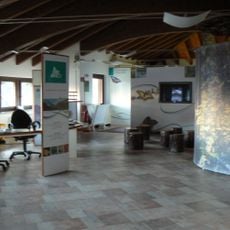
Area funeraria fuori Porta Decumana, Roman necropolis and archaeological museum in Aosta, Italy.
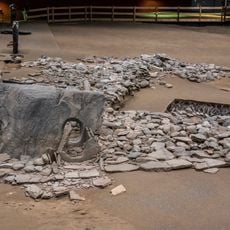
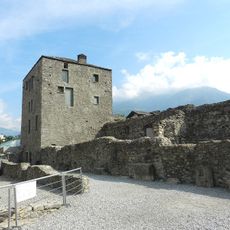
The Area funeraria fuori Porta Decumana is a Roman necropolis divided into two parts: part A near the road to the Alpis Graia and part B behind it. It holds pit, cappuccina and small-chamber tombs, three fourth-century mausoleums called Cellae memoriae, and a paleochristian basilica a few metres west of them.
The necropolis was laid out in the 1st century AD outside the Porta Decumana, along the road to the Alpis Graia, today's Little St Bernard Pass. In the 2nd century inhumation replaced cremation, and during the 2nd and 3rd centuries tombs overlapped and lost their orientation. Three mausoleums, the Cellae memoriae, were built in the 4th century over earlier graves and stayed in use through the early Middle Ages, while the nearby early Christian basilica was abandoned at the end of the 1st millennium.
The three fourth-century mausoleums are called Cellae memoriae, "memory chambers". The two western ones held numerous formae, burial niches; the eastern one, with a travertine altar block and no tombs, served as a mensa for the funeral banquet known as refrigerium.
The site opens to the public only on the first Wednesday of each month, from 14:00 to 18:00, and admission is free. It lies about 200 metres outside the Porta Decumana, along the road that led to the Alpis Graia, today's Little St Bernard Pass. Visits are therefore tied to that single monthly opening.
The three fourth-century mausoleums are called Cellae memoriae in Italian sources and Collinæ memoriæ, "hills of memory", in the French account. The eastern building has no burials: it holds a travertine block used as an altar, interpreted as a table for the refrigerium, the funeral banquet held in memory of the dead.
The community of curious travelers
AroundUs brings together thousands of curated places, local tips, and hidden gems, enriched daily by 94,369 contributors worldwide.