Abu Darweesh Mosque, Black and white striped mosque in Jabal Ashrafieh, Amman, Jordan.
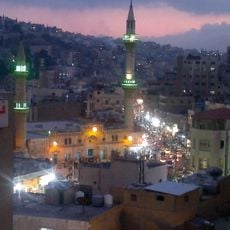
Abu Darweesh Mosque is a mosque in the Jabal Ashrafieh neighborhood of Amman, Jordan, instantly recognizable by its alternating bands of black and white stone that cover the entire exterior. The facade is decorated with geometric patterns, and the building includes prayer halls and rooms used for religious instruction.
The mosque was founded by Mustafa Hassan Sharkass, a Circassian carpenter and landowner from Sarkhomi in the Caucasus, born in 1903 and known as Abu Darwish. In summer 1959 he gave up plans for a private house and decided to build a small mosque on the sparsely settled hill facing Bashir Hospital, backed by former prime minister Saʿid al-Mufti and education minister Ali al-Jabari, who wanted a school attached and pledged 2000 JD a year. Work finished in November 1961 under the Christian contractor Sami Nimeh at a cost of 85,000 JD; a study library followed in 1967.
The mosque remains a familiar gathering point for many Palestinian families who settled in Jabal Ashrafieh over the decades. The black and white stone pattern gives the building an immediate visual identity that people in the neighborhood recognize from a distance.
Entry to the mosque is restricted to Muslims only, so non-Muslim visitors cannot go inside. The building is clearly visible from across Amman on its hill in al-Ashrafiyya, opposite Bashir Hospital. The prayer hall holds 2,000 to 3,000 worshippers across three levels, and a madrasa with a study library occupies part of the complex.
The former Jordanian diplomat and local historian Seleem Ayoub Quna compared the building to Cairo's al-Azhar Mosque and the architecture of Kairouan in Tunisia. From 1974 until 1984 the mosque served as the broadcast site for Amman's joint muezzin call, the adhan, before that role passed to the newly built King Abdullah Mosque.
The community of curious travelers
AroundUs brings together thousands of curated places, local tips, and hidden gems, enriched daily by 93,103 contributors worldwide.