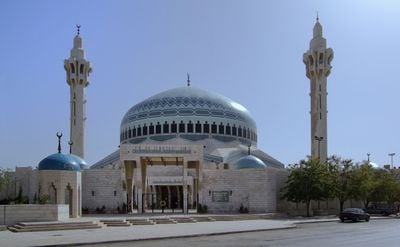
King Abdullah I Mosque, Mosque in Abdali district, Amman, Jordan
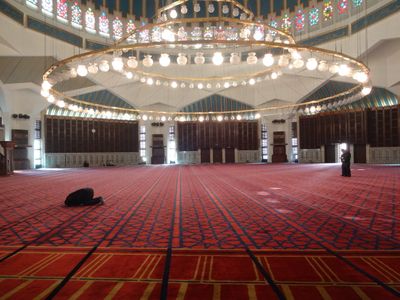
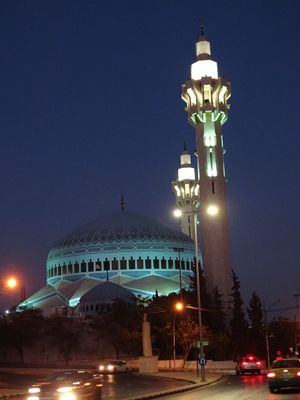
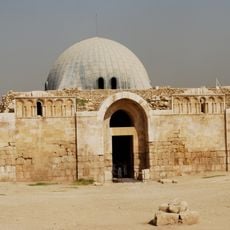
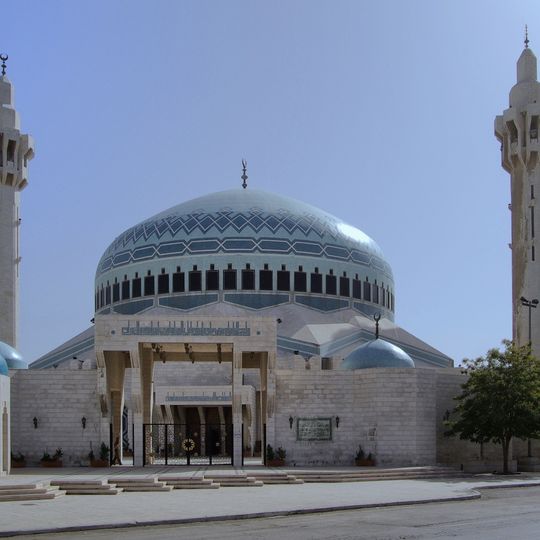
King Abdullah I Mosque is an octagonal prayer house in the Abdali district with a striking turquoise dome reaching 31 meters high and 35 meters in diameter, built without internal supporting columns. The interior holds 3,000 worshippers in the main prayer hall and a separate section for 500 women, with air conditioning throughout the building.
The mosque was founded in 1982 when King Hussein bin Talal laid the cornerstone, and it was built in two construction phases until completion in 1989. The project was created as a tribute to King Abdullah I, who founded modern Jordan.
The Islamic Museum, a 150-square-metre space, has two wings: one holds relics and manuscripts of King Abdullah I bin Hussein, the other Islamic antiquities plus photographs and models of Islamic archaeological sites in Jordan. The mosque also houses a library of over 20,000 books and a school for teaching the Quran.
Tourists may enter, but men need long trousers and women must cover head, arms and legs; a hooded gown is lent free at the entrance. The prayer hall, royal box, library and Islamic museum sit within one complex, so allow time to move between them. The site lies in the Abdali area, near the city centre.
The octagonal hall is roofed by a dome 35 metres across and 31 metres high, carried on the outer walls with no columns inside. The second minaret and a further dome were added only in the final phase, finished on 5 April 1989.
The community of curious travelers
AroundUs brings together thousands of curated places, local tips, and hidden gems, enriched daily by 93,107 contributors worldwide.