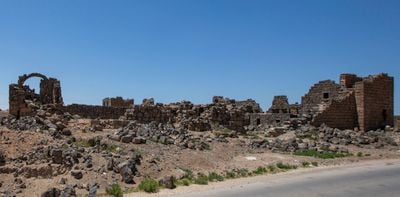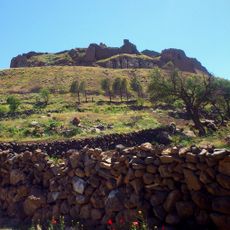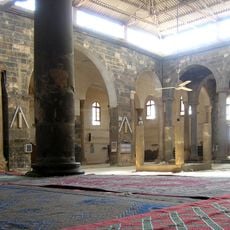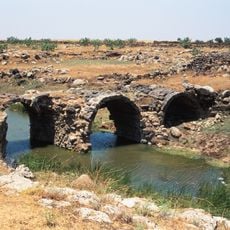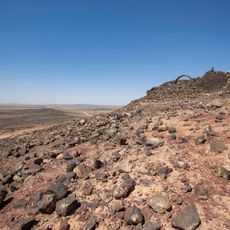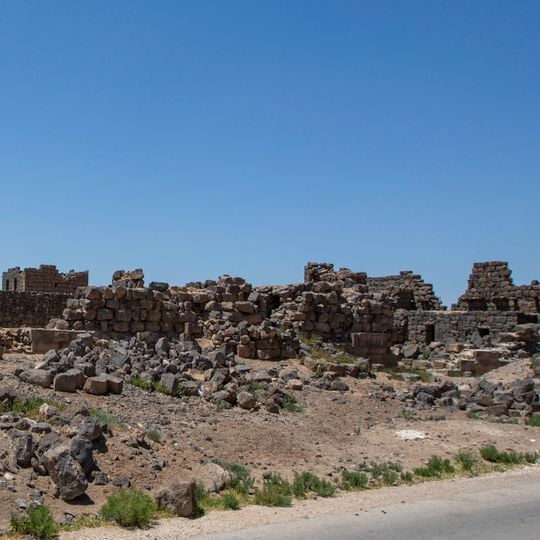
Deir el-Kahf, Roman fort in Mafraq Governorate, Jordan.
Deir el-Kahf is a Roman fort of local dark basalt in Mafraq Governorate, Jordan. Its late-antique walls form a near-square enclosure about 60 by 60 m, roughly 1.50 m thick and standing up to 7.50 m; the south-east curtain is the most damaged, and no roofs remain. Rectangular openings pierce the standing sections, and a single gate without flanking towers sits in the north-east wall.
A square fort without towers, about 28 by 28 metres, was built in the Severan period beside the Via Severiana, the road laid out around 208–210 under Septimius Severus. In late antiquity the Romans enlarged it into a roughly 60 by 60 metre quadriburgium with walls up to 7.5 metres high, reusing masonry from the earlier fort. Alfred von Domaszewski and Rudolf Ernst Brünnow surveyed and photographed it in 1898.
The name Deir el-Kahf means "Cave Monastery", although the site is a Roman fort; the Arabic name was attached later. The fort stands between two wadis that merge just southeast of the walls, and the Romans dammed their seasonal flow; that dam is still in use. Around the ruins a large village grew up in the 20th century, and the land is farmed again.
The fort stands on flat ground between two wadis that merge just southeast of the walls; a Roman dam there still holds back seasonal runoff. The Syrian border lies about 3 km north, and the site is reached by local roads off the Via Severiana, the Roman frontier road built around 208–210 under Septimius Severus. A village of the 20th century now surrounds the ruins.
The fort sits between two wadis coming from the Jebel el-Druze; just southeast of the ruins they merge, and the Romans dammed their seasonal flow with a dam still in use. Rain peaks in December, and the Syrian border lies only 3 km north.
The community of curious travelers
AroundUs brings together thousands of curated places, local tips, and hidden gems, enriched daily by 93,166 contributors worldwide.