Hara Castle, Japanese castle ruins in Minamishimabara, Japan
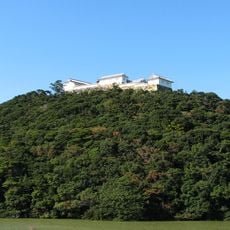
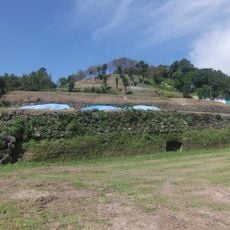
Hara Castle is a ruined castle on a hill above the Ariake Sea, with a long sloped stone wall of dark, roughly squared stones laid in even courses and divided into rectangular panels. Above the wall, a grassy slope with bare-branched trees rises to the castle grounds. The site includes the Honmaru, Ninomaru, Sannomaru, Amakusa-maru and Demaru enclosures, with stone walls, a masugata gate complex and the foundation of the tenshu tower.
Arima Takazumi built Hara Castle in 1496 as a branch castle of Hinoe Castle. Around 1599–1604 Arima Harunobu rebuilt it as his main stronghold with tiled roofs and stone walls. Abandoned in 1616, it sheltered about 37,000 rebels during the Shimabara Rebellion of 1637–1638. After the revolt the shogunate demolished its remaining walls and structures.
The castle was blessed for Christian use in 1604, as recorded in a Jesuit annual report. Excavations have unearthed rosaries, crucifixes, medals and fragments of roof tiles bearing a flower-cross design, the first such find from a castle owned by a Christian daimyo. A stone Jizo tower called Honekami Jizo was erected on the site in 1766 to memorialize the dead of both sides.
The terrain is somewhat hilly and requires steady footing when exploring the different levels of the site. Visitors should wear appropriate footwear and allow enough time to walk through the various sections of the ruins.
Excavations revealed remains of one of the largest castle gates in Japanese history along with lead bullets from battle. These findings show the scale and intensity of fighting that occurred at this location.
The community of curious travelers
AroundUs brings together thousands of curated places, local tips, and hidden gems, enriched daily by 93,181 contributors worldwide.