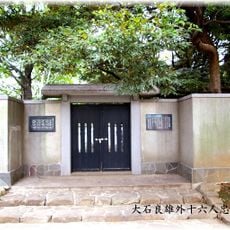
Gyoran-ji, Buddhist temple in Minato-ku, Japan.
Gyoran-ji is a Buddhist temple of the Tendai-related Mita-san Suigetsu-in line on the slope of Gyoran-zaka in 4-chome Mita, Minato-ku. Its main hall enshrines the Gyoran Kanzeon Bosatsu, a statue of a maiden with her hair tied in a Chinese-style topknot, said by tradition to have been carved by Kukai. The temple is the 25th stop on the Edo Thirty-Three Kannon pilgrimage.
The temple began around 1617 as Gyoran-in, a subtemple of Enno-ji in Nakatsu, Buzen Province, founded by Shōyo. In 1652 Shōyo built a Kannon hall on the present site in Mita and moved the main image there. The temple, formally Mita-san Suigetsu-in Gyoran-ji, is the 25th stop on the Edo Thirty-Three Kannon pilgrimage.
The name comes from the main image, Gyoran Kanzeon Bosatsu, a maiden with hair tied in a Tang-style topknot holding a fish basket, modelled on the Chinese tale of the Buddha appearing as a fish-selling girl. The temple is the 25th stop on the Edo Thirty-Three Kannon pilgrimage, and the grave of Naito Nobutomo, a hatamoto of the Naito branch family, lies in its cemetery.
The temple can be reached by Tokyo Metro's Namboku and Toei Mita lines, exiting at Shirokane-Takanawa station at exit A2. The grounds are easy to explore on foot and visitors should allow time to walk through all areas of the complex.
The main image is not a Buddha but Gyoran Kanzeon Bosatsu, a maiden with her hair tied in a Tang-style topknot, said by tradition to be carved by Kukai. It depicts the Tang legend of the Buddha appearing as a beautiful maiden selling fish from a bamboo basket to spread the dharma.
The community of curious travelers
AroundUs brings together thousands of curated places, local tips, and hidden gems, enriched daily by 93,258 contributors worldwide.