Mount Azumaya, Volcanic summit in Nagano, Japan
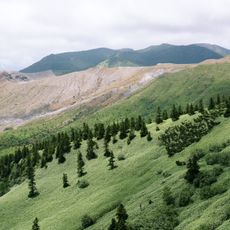
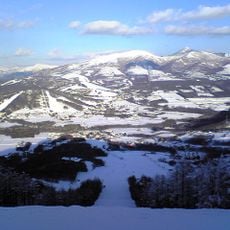
Mount Azumaya is a 2,354-metre andesite stratovolcano on the border of Nagano and Gunma Prefectures. Its broad, rounded summit rises above snow-streaked upper slopes and dark reddish-brown lower flanks cut by shallow ravines. It is the southern peak of the Azumaya Volcano group, which also includes Mount Neko, Mount Urakura and Mount Kimyō.
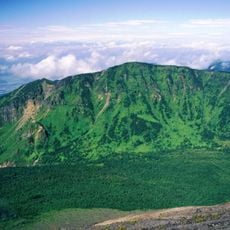
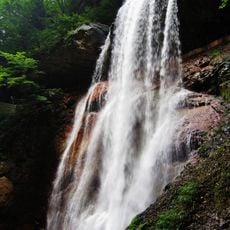
Mount Azumaya is a stratovolcano built by andesite lava flows between about 800,000 and 300,000 years ago. An eruption 340,000 years ago formed a caldera roughly 3 km across, later eroded into the ring of peaks called Azumaya Volcano: Mount Neko (2,207 m) to the west, Mount Urakura (2,091 m) to the east and Mount Kimyō to the north. The caldera is breached on the north side, where the Yonako River flows out past the Yonako Great Waterfall.
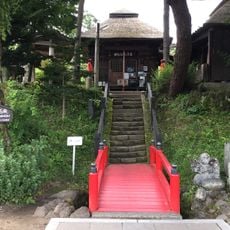
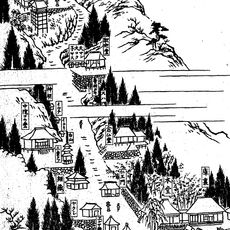
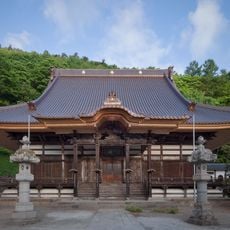
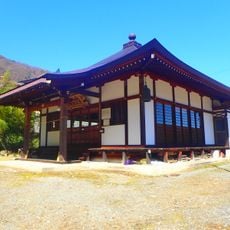
The mountain is also called Agatsuma-yama, written 吾妻山 in Tsumagoi village and 吾嬬山 elsewhere. At the summit stand the East and West Palaces of Yamaya Shrine's Okumiya; the shrine buildings were rebuilt and a relocation ceremony held in 2018 for the 1300th anniversary of the mountain's opening. On the southern middle slope sits Nishihanadoji, the shrine's Nakamiya.
Multiple trails lead up to the summit, with a cable car available during summer months for easier access from lower elevations. Weather conditions can change quickly at this altitude, so proper preparation is advisable.
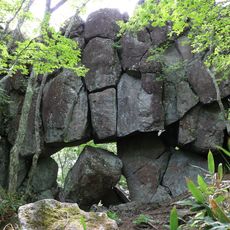
On the southern slope stands Matoiwa, a large pyroxene andesite dyke whose hexagonal columns look like stacked bales; it is a designated national natural monument. The summit holds the East and West Palaces of Yamaya Shrine's Okumiya, rebuilt in 2018 for the 1,300th anniversary of the mountain's opening.
The community of curious travelers
AroundUs brings together thousands of curated places, local tips, and hidden gems, enriched daily by 93,358 contributors worldwide.