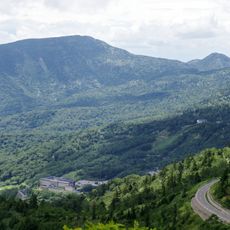
Mount Kusatsu-Shirane, Active stratovolcano in Kusatsu, Gunma Prefecture, Japan
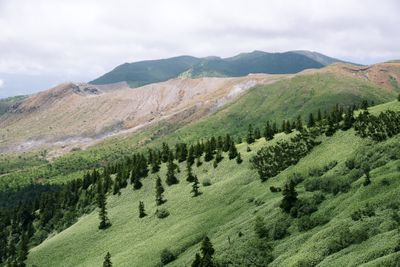
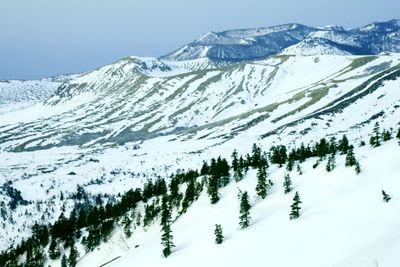
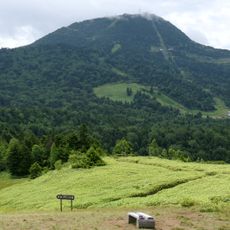
Mount Kusatsu-Shirane is a 2,160 m active volcano in Kusatsu, Gunma Prefecture, made of overlapping pyroclastic cones. Its summit holds three crater lakes; the largest, Yu-gama, is about 300 m across, some 30 m deep and roughly 18 °C, with turbid blue-green water near pH 1. Snow patches and bare ground streak the upper slopes, and dark conifers stand on the lower ones.
Records document volcanic eruptions across several centuries, with the peak repeatedly ejecting material from overlapping pyroclastic cones. An eruption in January 2018 caused an avalanche on the slopes and led to temporary closure of hiking trails.
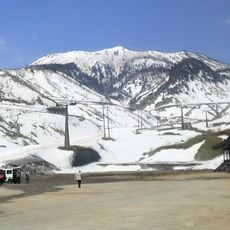
The official name is Shirane-yama; the prefix Kusatsu distinguishes it from Nikkō-Shirane across Gunma Prefecture. Sulfur was mined at Yu-gama's shore from before World War II until around 1960, when trolleys and lifts carried the ore and offices and work sheds stood by the crater rim. The crater rim observation deck looks onto the lake.
Access is by National Route 292 (Shiga-Kusatsu Road); from the rest house a walkway leads about 10 minutes to the Yugama crater rim. Buses from Kusatsu Onsen and Naganohara-Kusatsuguchi Station run to the Shirane-Kazan stop, which may be closed when volcanic gas concentrations are high. Entry within 500 m of the Yugama crater is restricted even at alert level 1, and the road closes during periods of increased volcanic activity.
Sulfur deposits float on the surface of Yu-gama, creating a yellow pattern amid the emerald color of the water. The overlapping arrangement of multiple pyroclastic cones creates an unusual topography at the summit, different from most other Japanese volcanoes.
The community of curious travelers
AroundUs brings together thousands of curated places, local tips, and hidden gems, enriched daily by 92,789 contributors worldwide.