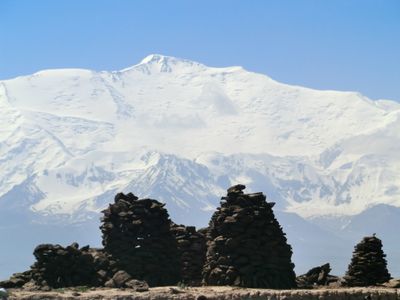
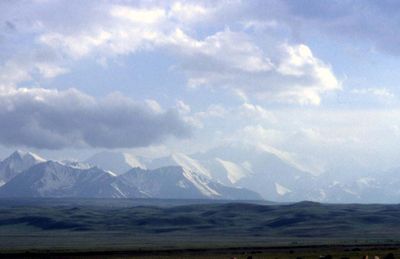
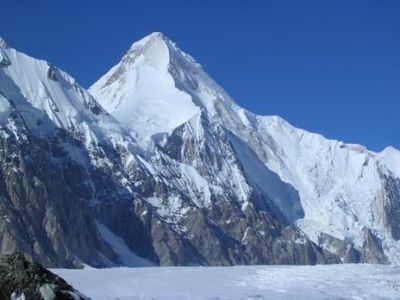
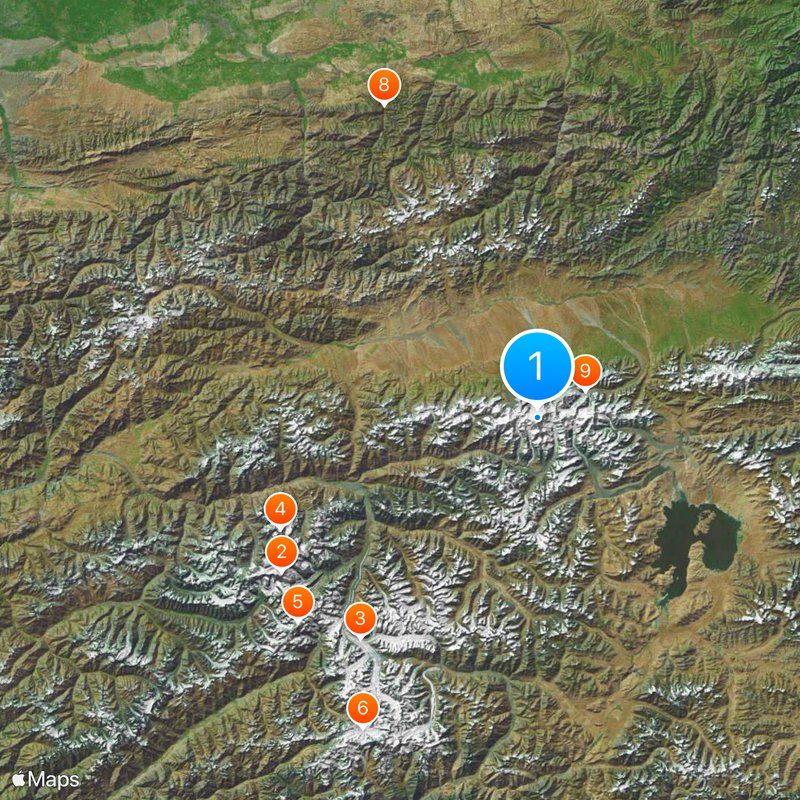
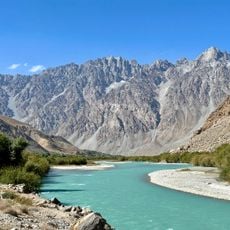
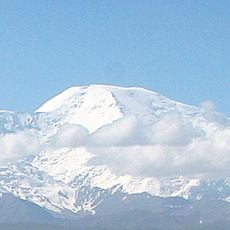
Lenin Peak, Mountain summit between Osh Region, Kyrgyzstan and Gorno-Badakhshan, Tajikistan.
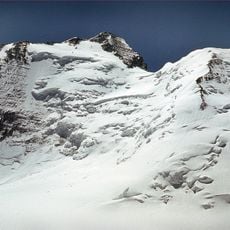
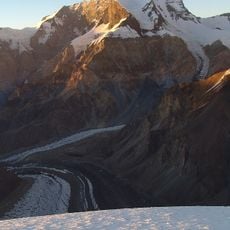
Lenin Peak, at 7,134 meters in the Trans-Alay Range on the Kyrgyzstan–Tajikistan border, is a broad, rounded snow- and ice-covered massif with dark grey rock ridges breaking its upper slopes. Its lower slopes drop to dark rock and foothills above a wide, flat plain. Sixteen climbing routes exist, nine on the south slope and seven on the north.
Alexei Fedchenko first described the peak in 1871 and named it Mount Kaufmann after Konstantin Kaufman, Governor-General of Turkestan; it was renamed Lenin Peak in 1928. On 25 September 1928 the Germans Karl Wien and Eugen Allwein and the Austrian Erwin Schneider reached the top via the northeast ridge from the Krilenko Pass saddle, then the highest summit attained. Soviet climbers Kasian Chernuha, Vitaly Abalakov and Ivan Lukin climbed it on 8 September 1934 past the rocks later named Lipkin's Rocks.
The Kyrgyz name Jel-Aidar means "Wind's God," and Achyk-Tash, "Open Rock," also names the 3,600 m plateau and base camp on the northern route. In Tajikistan the peak is officially Qullai Abuali ibni Sino, after the physician and philosopher Avicenna, while Kyrgyzstan still uses Lenin Chokusu.
The climbing season requires about three weeks of preparation with multiple acclimatization periods at different camps starting from the base at 3,600 meters. Climbers need solid mountaineering experience and physical fitness, as the ascent involves adapting to high altitude before reaching the summit.
On 27 July 1968, 46 Soviet paratroopers jumped onto the summit in the first such parachute drop in the sport's history; four died, including instructor Vyacheslav Tomarovich. Thirty-five years later, on 14 August 2003, six Russian parachutists led by Dmitry Kiselev landed on the top at 13:20.
The community of curious travelers
AroundUs brings together thousands of curated places, local tips, and hidden gems, enriched daily by 93,362 contributors worldwide.