Suraksan, Mountain summit in Seoul and Gyeonggi Province, South Korea
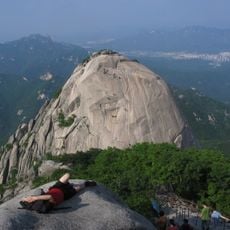
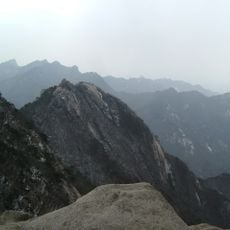
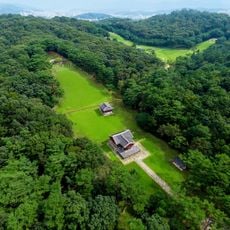
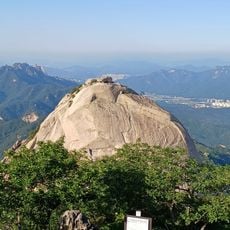
Suraksan is a mountain summit located on the border between northeastern Seoul and Gyeonggi Province, reaching 637 meters above sea level. The mountain connects several districts and cities and can be approached from multiple trailheads, each leading to paths of different difficulty.
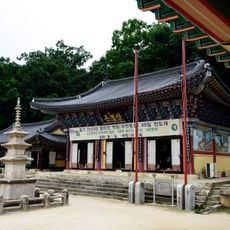
Suraksan's slopes hold Heungguksa, a temple founded during the Silla period, and Seongnimsa, built in the Joseon period. The mountain is listed in the San-gyeongpyo as part of the Hanbuk Jeongmaek range, and the Yeojidoseo records it in Dunya-myeon, extending south from Chukseongnyeong in Pocheon. A 2 m stone Maitreya standing statue behind Naewonam Hermitage is estimated to predate the Goryeo period.
The name Suraksan (水落山, "water falling mountain") comes from legends tied to the valley near Naewonam Hermitage, where water cascades over surrounding rock walls; another tale says a hunter's son named Su-rak was taken by a tiger there, and his father's calls echo in the rain. The mountain appears in the San-gyeongpyo as part of the Hanbuk Jeongmaek range.
Suraksan can be reached from several trailheads, including one near a local train station, making it accessible without a car. Solid footwear is strongly recommended, as some sections of the trail are steep and rocky.
At the steepest points, steel cables are fixed directly into the rock to help hikers grip their way through difficult passages. Using these cables is considered completely normal in Korea and is built into the trail design rather than being treated as a last resort.
The community of curious travelers
AroundUs brings together thousands of curated places, local tips, and hidden gems, enriched daily by 93,465 contributors worldwide.