Beket-Ata mosque, Underground mosque in Mangystau Province, Kazakhstan.
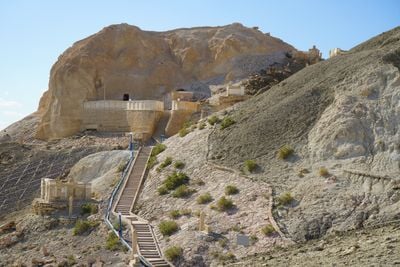
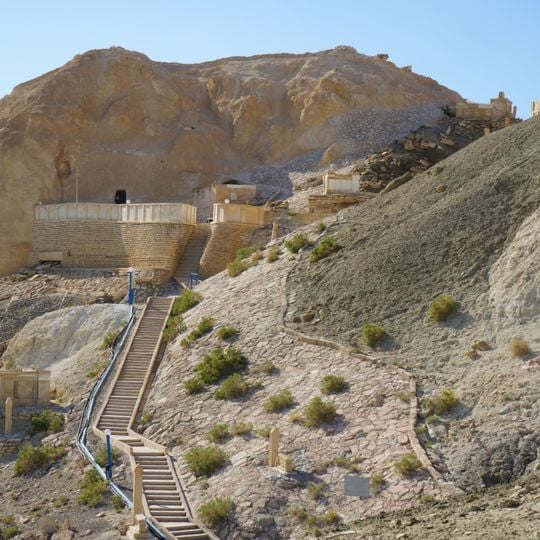
The Beket-Ata mosque is cut into the pale rock of the Oglandy hill in the western chink of the Ustyurt. It consists of five round chambers, with a mihrab niche in the southwestern one; light openings pierce the dome of the northern room, where Beket-ata was buried in a niche. A curved retaining wall of light stone blocks and stairways with blue railings lead up to the opening.
Beket-ata, born in 1750, studied in Bukhara and returned to the region, where he founded five mosques; this rock-cut mosque at Oglandy served as his refuge, and he was buried in a niche of its northern chamber. The complex was first studied systematically only from the late 1960s, surveyed in 1973 under architect Malgabar Mendikulov. It was listed as a monument of republican significance in 1982, restored in 1999–2003, and inscribed by UNESCO in 2026.
Pilgrims call the site Beket ata, after the healer and scholar born in 1750 who studied in Bukhara and is said to have built five mosques. His body was laid in a niche cut into the base of one chamber, and the horns of an argali hang in the mihrab niche. Visitors today come to pray at his grave.
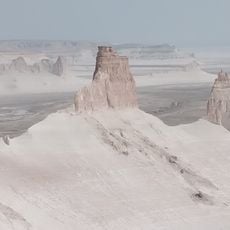
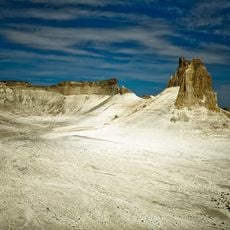
The mosque lies 61 km east-northeast of Seneke in the Oglandy tract, on the western chink of the Ustyurt, and a road from Aktau was built in 2010–2011. The site is reached by stone staircases with blue metal handrails, one straight and one zigzagging up the slope. The chambers are cut into the rock, so expect uneven footing and steps.
The mosque is one of five that Beket-ata built after studying in Bukhara, according to local accounts. He is said to have died at the Prophet's age, and his body was placed in a niche cut into the base of one of the chambers, which pilgrims still visit day and night.
The community of curious travelers
AroundUs brings together thousands of curated places, local tips, and hidden gems, enriched daily by 93,465 contributors worldwide.