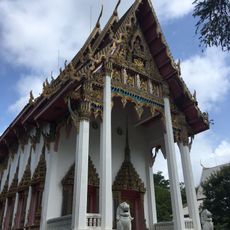
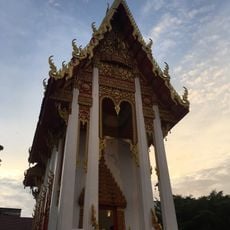
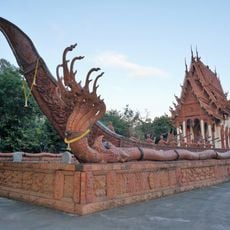
Champasak cultural landscape, Archaeological site in Champasak Province, Laos.
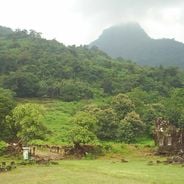
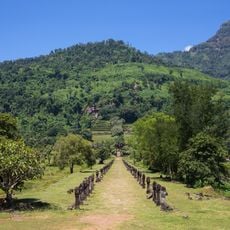
The Champasak cultural landscape is a planned garden over 1,000 years old, laid out geometrically along about 10 km between the Mekong River and Phu Kao mountain. It combines temple ruins, sanctuaries and water channels, including two planned cities on the Mekong banks and the ruined Hindu temple of Wat Phou at the foot of the mountain.
A civilization existed around Champasak by the 6th century. From the 10th century Khmer rule expanded here and Wat Phou was built as a Hindu foundation; the site represents development from the 5th to the 15th century, mainly under the Khmer Empire. From about the 13th century Tai-Lao peoples moved south; under Theravada Buddhism most monuments, including Wat Phou, were treated as Buddhist temples.
Wat Phou was built as a Hindu temple, then treated as a Buddhist monastery after Tai-Lao peoples settled the area from around the 13th century. The name Wat Phou means "mountain temple"; the Lao reclassified what may have been a citadel as a temple. The site's layout expresses a Hindu vision of the relationship between nature and humanity.
The site covers 390 km², with the temple complex at the foot of Phu Kao and the ancient city of Kurkshetra about 6.5 km east on the west bank of the Mekong. The sanctuary sits on a slope, so allow time for the climb. The protected area was designated in 1988 and enlarged by presidential decree in 1997.
The layout is geometric: temples, shrines and water channels were aligned across roughly 10 km to express a Hindu view of nature and humanity, with the Phu Kao mountain and two planned towns on the Mekong banks forming part of the site. The complex developed mainly from the 5th to the 15th century under the Khmer Empire.
The community of curious travelers
AroundUs brings together thousands of curated places, local tips, and hidden gems, enriched daily by 93,529 contributors worldwide.