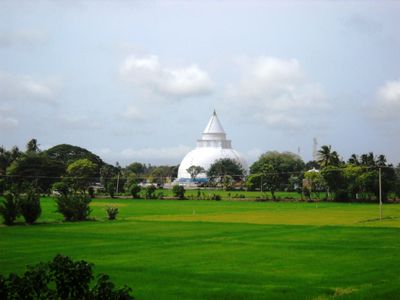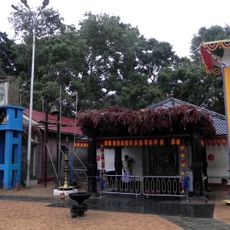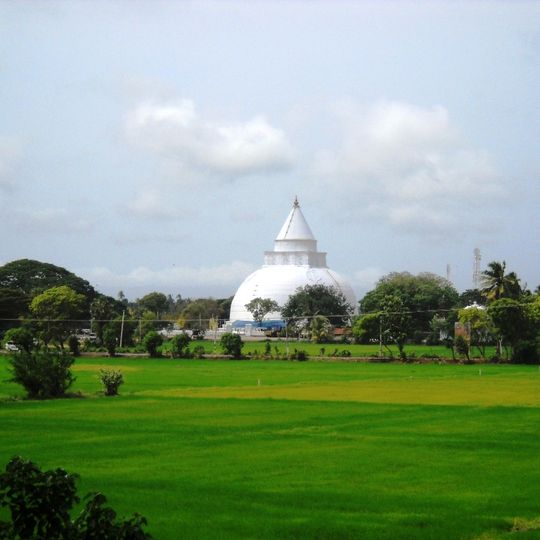
Tissamaharama Raja Maha Vihara, Buddhist temple in Tissamaharama, Sri Lanka.
Tissamaharama Raja Maha Vihara is a Buddhist monastery in Tissamaharama, Southern Province, Sri Lanka. Its stupa, the Tissamaharama Dagoba, is the largest in southern Sri Lanka, 156 feet high and 550 feet in circumference. It has a bubble-shaped brick dome on a square granite platform, with a white square drum and tapering conical spire above.
The Mahavamsa records that King Kavan Tissa of Ruhuna built the monastery in the 2nd century BC as Silapassa Pirivena; some historians instead credit King Mahanaga in the 3rd century BC. King Ilanaga expanded and renovated it in 38 AD, and kings Voharaka Tissa, Vijayabahu I and others restored the stupa over the following centuries. Kalinga Magha's armies raided the site in the 13th century, and it was abandoned in the 18th century under Dutch colonial rule. In 1858 the monk Wepathaira Sumana began the modern restoration.
The temple serves as a gathering place for local devotees during religious observances and daily worship throughout the year. Visitors can see people circumambulating the main structure and presenting flower offerings as part of their spiritual practice.
Cover your shoulders and knees when visiting, and remove your shoes before entering to show respect for the sacred space. Morning hours offer a quieter experience as the site becomes busier with visitors and worshippers as the day progresses.
The stupa enshrines relics whose identity is debated: the Mahavamsa names the frontal bone relic, while a pillar inscription found at Kirinda indicates the left tooth relic was also placed here. Some hold that the frontal bone relic was later moved to Seruwila Mangala Raja Maha Vihara.
The community of curious travelers
AroundUs brings together thousands of curated places, local tips, and hidden gems, enriched daily by 93,529 contributors worldwide.