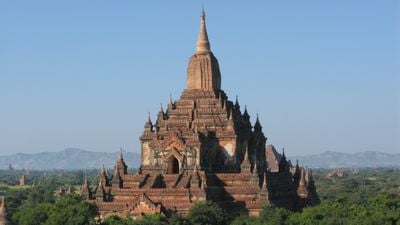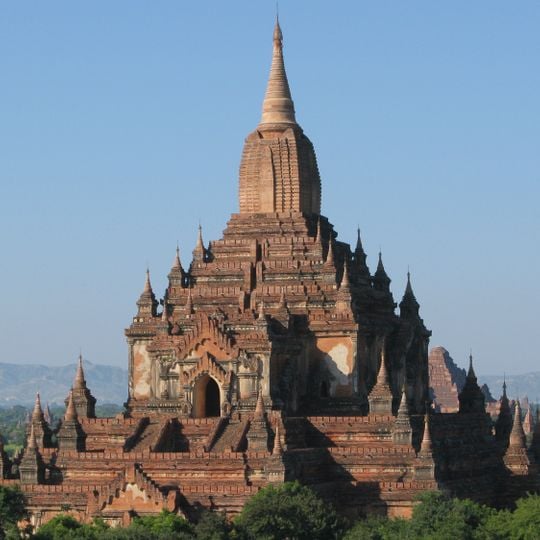
Sulamani Temple, Buddhist temple in Minnanthu, Myanmar.
Sulamani Temple is a Buddhist temple in the village of Minnanthu, within the archaeological zone of Bagan, Myanmar. It has a square plan with two main levels, the lower carrying three receding terraces and the upper carrying four, all topped by a central stupa.
King Narapatisithu had the temple built in 1183, and the name comes from the Burmese words for small ruby, which was reportedly found at this spot before construction began. After the 2016 earthquake caused serious damage across Bagan, restoration work was carried out at this site along with many others in the area.
The walls inside carry painted scenes from Buddha's life, along with figures of Naga snakes and other mythological beings that appear repeatedly in Burmese religious art. Terracotta plaques telling stories from the Jataka tales run along the outer surfaces, giving the building a kind of illustrated surface that rewards a slow walk around it.
Access to the Bagan archaeological zone requires a pass that covers all temples in the area, so it is best arranged before heading out. The site sits in the eastern part of Bagan, and most visitors reach it by bicycle or electric scooter since the paths between temples are flat and easy to follow.
After the 2016 earthquake, a team from the Zamani Project scanned the entire temple using 3D technology, producing a digital record of the architecture down to a fine level of detail. That record is publicly available, meaning researchers anywhere in the world can study the building without visiting Bagan.
The community of curious travelers
AroundUs brings together thousands of curated places, local tips, and hidden gems, enriched daily by 91,690 contributors worldwide.