Ascensor da Bica

Log in to your account

AroundUs is a community-driven map of interesting places, built by curious explorers like you. It grows with every review, story, and photo you share.
Connect to save your favorite spots, contribute locations, and create personalized routes.
By continuing, you accept our Terms and Conditions and our Privacy Policy
Add to collection
Map
Suggest a change
Share

Ascensor da Bica, Funicular in São Paulo district, Lisbon, Portugal.

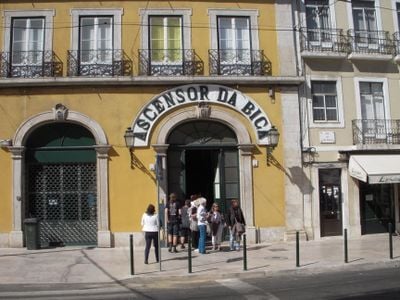
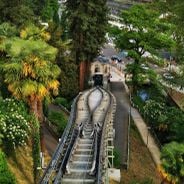
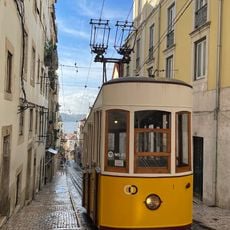
The Ascensor da Bica is a funicular railway in Lisbon that climbs a steep slope over approximately 260 meters, linking lower and upper neighborhoods. Two counterbalanced cars move simultaneously in opposite directions along the narrow Rua da Bica de Duarte Belo, managing the challenging terrain.

The funicular began operating in 1892 with a water-powered counterbalance mechanism designed by engineer Raoul Mesnier du Ponsard. This engineering solution addressed the need for efficient transportation in Lisbon's steep neighborhoods during the late 1800s.

The funicular is woven into daily life in Lisbon, used by locals to navigate steep neighborhoods and by visitors seeking an authentic city experience. Its bright yellow color has made it a symbol of the area, representing how residents adapt to challenging terrain.

The funicular operates throughout the week with adjusted hours on different days, making it convenient for both regular commuters and casual visitors. The ride is brief and straightforward, offering a quick way to ascend or descend the steep neighborhood.

The system holds the status of a National Monument of Portugal, reflecting the country's engineering heritage from the late 1800s. While the water-powered mechanism has been upgraded over time, the structure remains a testament to that era's innovative solutions.

Location: Misericórdia

Official opening: 1892

Length: 260 m

Part of: funiculaires de Lisbonne

GPS coordinates: 38.70870,-9.14678

Latest update: December 6, 2025 16:04

Photos
Architectural monuments of Lisbon

Lisbon connects Moorish fortifications with structures from the Age of Discoveries and contemporary architecture. The city evolved from its medieval hilltop castle through the 16th-century Manueline monasteries to modern cultural buildings along the Tagus waterfront. This route passes through neighborhoods and periods that document Lisbon's architectural development. In Belém, the Tower of Belém and the Jerónimos Monastery represent the Manueline style, which combines maritime motifs with Gothic and Renaissance elements. The Castle of São Jorge stands above Alfama, the city's oldest district with narrow streets and viewpoints such as the Miradouro de Santa Luzia. In the city center, Rossio Square marks the start of Baixa, the district rebuilt systematically after the 1755 earthquake. The collection also includes religious buildings such as the Basilica da Estrela and the Church of São Roque with its gilded chapels, the Pantheon of Santa Engrácia with its dome, and the ruins of the Convento do Carmo. More recent projects like the MAAT Museum and the Oceanário show Lisbon's approach to contemporary architecture. Historic Tram 28 connects many of these sites and runs through Chiado, Bairro Alto and Graça. Outside the city, the National Palace of Sintra and the Moorish Castle complete the picture.

The most spectacular funiculars in the world

Funiculars have transported passengers up mountains and hills in cities worldwide for over a century. This collection covers 25 installations across five continents, from the Como-Brunate railway in Lombardy to the Fløibanen in Bergen, Norway. Some handle substantial elevation changes, such as the Niesenbahn in Switzerland with 710 meters (2,329 feet) of vertical ascent, while others cover shorter distances through urban neighborhoods like the Bica funicular in Lisbon or the ascensores in Valparaiso. The systems range from heritage operations like the Great Orme Tramway in Wales, opened in 1902, to modern installations such as the Stanserhorn CabriO in Switzerland with its double-decker open-top design. Several serve primarily as tourist attractions, including the Peak Tram in Hong Kong and the Montmartre funicular in Paris, while others remain essential transport links for residents and visitors, such as the Wellington Cable Car in New Zealand and the Heidelberger Bergbahn in Germany. Each offers access to viewpoints, historic districts or mountain facilities that would otherwise require lengthy walks or drives.

Reviews

Visited this place? Tap the stars to rate it and share your experience / photos with the community! Try now! You can cancel it anytime.

« Ascensor da Bica - Funicular in São Paulo district, Lisbon, Portugal » is provided by Around Us (aroundus.com). Images and texts are derived from Wikimedia project under a Creative Commons license. You are allowed to copy, distribute, and modify copies of this page, under the conditions set by the license, as long as this note is clearly visible.

Discover hidden gems everywhere you go!

From secret cafés to breathtaking viewpoints, skip the crowded tourist spots and find places that match your style. Our app makes it easy with voice search, smart filtering, route optimization, and insider tips from travelers worldwide. Download now for the complete mobile experience.
Around Us App Screenshot

A unique approach to discovering new places

Le Figaro

All the places worth exploring

France Info

A tailor-made excursion in just a few clicks

20 Minutes