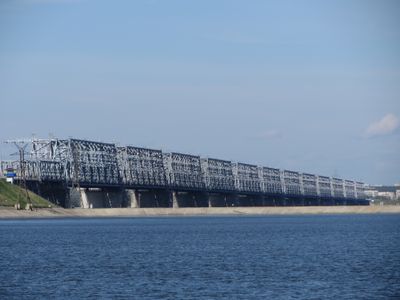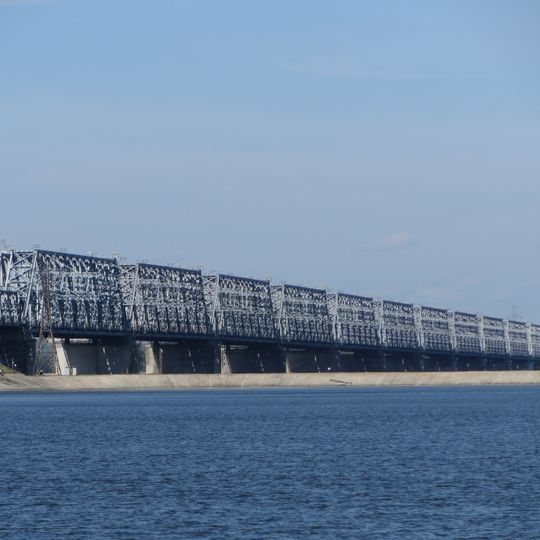
Emperor Bridge, Railway and road bridge in Ulyanovsk, Russia
Emperor Bridge is a combined railway and road crossing in Ulyanovsk that stretches over 2111 meters of water, linking both sides of the city across the Kuibyshev Reservoir. It carries two railway tracks and two vehicle lanes, serving as part of the R178 highway.
Work began in 1913 after Interior Minister Pyotr Stolypin proposed linking the Volga-Bugulma and Moscow-Kazan railway lines. Construction was interrupted by World War I and the subsequent revolution, with completion only arriving several decades later.
The bridge takes its name from Tsar Nicholas II, who authorized its construction, and retains this title despite the political changes Russia has undergone since. Travelers crossing the span still encounter the original steel trusses designed by an engineer who shaped several other major railway crossings across the empire.
The crossing connects the two halves of the city and is used daily by trains and vehicles commuting between the shores of the reservoir. Pedestrians cannot cross the structure, so it is best viewed from the nearby waterfront areas.
During the initial construction attempt, workers lowered pneumatic caissons underwater to establish foundations, a technique rarely used in Russia at the time. This method allowed builders to create stable supports even in deep or fast-flowing sections of the river.
The community of curious travelers
AroundUs brings together thousands of curated places, local tips, and hidden gems, enriched daily by 91,535 contributors worldwide.