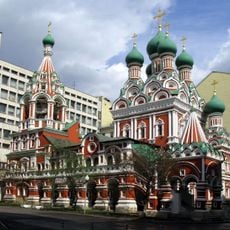
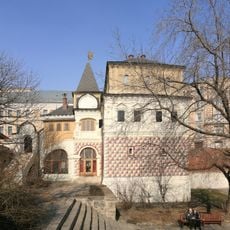
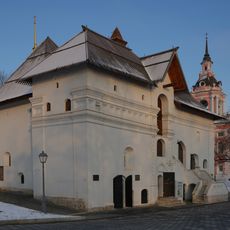
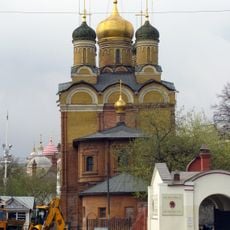
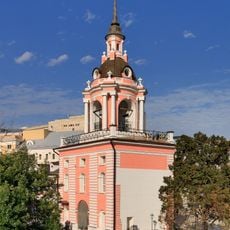
Church of Saint Nicholas Red Jingle Bell, Eastern Orthodox church in Tverskoy District, Russia
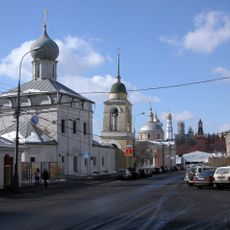
The Church of Saint Nicholas "Red Jingle Bell" stands in Kitay-gorod, Moscow, not Tverskoy District. The current building was erected in 1858 by merchant Vasily Antonov Polyakov on the site of a 16th-century church; its architect is unknown, possibly Alexander Shestakov or Nikolay Kozlovsky. It has a main altar dedicated to the Nativity of the Theotokos, a north chapel to Zosima and Savvaty of Solovki, and a south chapel to Saint Nicholas.
A stone church was first recorded here in 1561; it burned in 1626 and was renovated in 1691 with funds from the merchant Grigory Tverdikov. The old building was dismantled in 1854, and the merchant Vasily Antonov Polyakov financed the present church, consecrated on 2 November 1858. The architect is unknown, though Alexander Shestakov or Nikolai Kozlovsky, who designed the iconostasis, may have been responsible. Closed at the end of 1929, the building held Soviet offices and later an electrical substation before being returned to the Russian Orthodox Church in 1991 and reconsecrated on 19 December 1996.
The name "Red Jingle Bell" comes from the beauty of the church's bells; one bore three lilies, the letters L. T., a 1673 mark and a Latin inscription, and was probably taken as a trophy by Tsar Alexei Mikhailovich in the Polish war. That bell is now in the Kolomenskoye museum. The main altar is dedicated to the Nativity of the Theotokos, the north chapel to Zosima and Savvaty of Solovki, the south chapel to Saint Nicholas. Before the only pre-revolutionary icon of Saint Nicholas, the church's main relic, an akathist is read.
The church stands in Kitay-gorod, not Tverskoy District; the nearest metro is Kitay-gorod on the Tagansko-Krasnopresnenskaya and Kaluzhsko-Rizhskaya lines. The south chapel of Saint Nicholas is still occupied by an electrical substation, so only the main altar and the north chapel of Zosima and Savvaty are in use. Regular services are held at the main altar, and baptism in the north chapel.
The south chapel, dedicated to Saint Nicholas, still houses a transformer substation despite believers' requests to return it to worship use. The church's name comes from its bells, one of which, bearing three lilies and the date 1673, was probably taken as a trophy by Tsar Alexei Mikhailovich in the Polish war and is now in the Kolomenskoye museum.
The community of curious travelers
AroundUs brings together thousands of curated places, local tips, and hidden gems, enriched daily by 93,365 contributors worldwide.