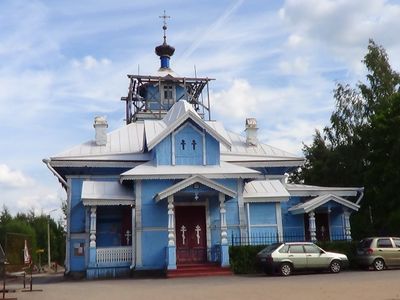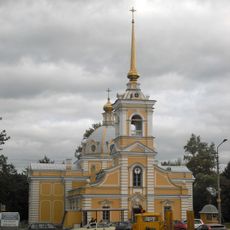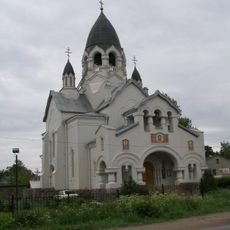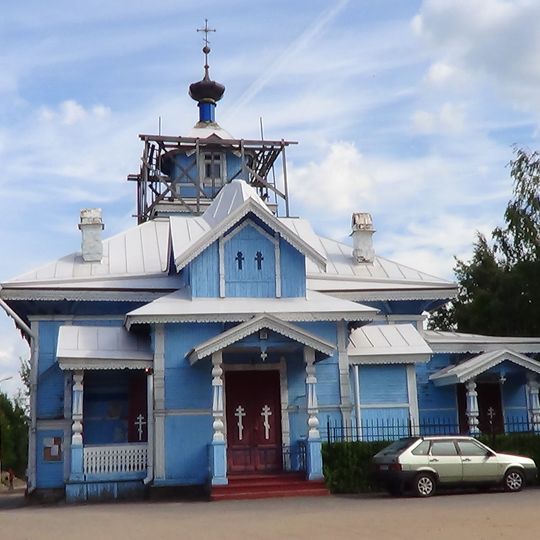
Saint Alexander Nevskiy church, Orthodox church in Krasnoe Selo, Russia.
Saint Alexander Nevskiy Church is a wooden Orthodox church built in 1890 in Krasnoye Selo, designed by military engineer Vladimir Kolyankovsky in the Russian style. It has a capacity of up to 500 people. A closed veranda was added on the south side in 1953. Inside are a wooden three-tier iconostasis and two tall icon cases with Corinthian columns, moved here after World War II from the Alexander Nevsky Church in Alexandrovka near Taytsy.
A first wooden church was built in 1885 for the Krasnoye Selo military hospital on the initiative of Grand Duke Vladimir Alexandrovich, designed by military engineer Vladimir Kolyankovsky and consecrated on 14 October 1885. When it decayed, donations from merchant A. F. Cherepennikov, honorary citizen P. Davydov, merchant V. A. Yudakov and hospital head Colonel V. N. Smelsky funded a new wooden church to Kolyankovsky's design, begun in April 1890 and consecrated on 28 July 1890 in the presence of the Grand Duke and Grand Duchess Maria Pavlovna. Closed on 21 November 1932, it was reopened during the German occupation in 1942 and again in 1947.
The church kept the Krasnoye Selo copy of the revered icon of Simeon the God-Receiver, found floating in a spring at Skachki on 11 May 1800, from 1946 until 18 May 2016, when it was moved to the new church on the finding site. The wooden three-tier iconostasis and two tall Corinthian-columned kiosks came after the war from the Alexander Nevsky church in Alexandrovka near Taytsy, built in the 1790s.
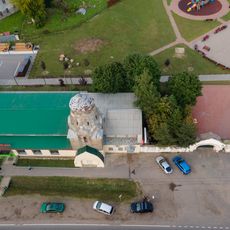
The church stands at 59.72669, 30.08562 in Krasnoye Selo, south of Saint Petersburg. It is an active parish of the Saint Petersburg eparchy, so entry during services is best avoided; the building holds up to 500 people. The 1953 glazed veranda on the south side marks the main approach.
The church kept the wonder-working icon of Simeon the God-Receiver, found floating in a spring at Skachki on 11 May 1800. After the Trinity church closed, believers saved it and gave it to this church after the war; in 2016 it was moved to a new church built at the finding site, and a same-size copy remains here.
The community of curious travelers
AroundUs brings together thousands of curated places, local tips, and hidden gems, enriched daily by 94,448 contributors worldwide.