Choban-Kule, Medieval fortress near Morske village, Crimea.
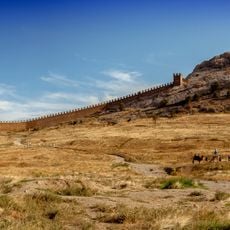
Choban-Kule is a medieval stone fortress near Morske village featuring thick defensive walls built in the fifteenth century. The tower rises above steep slopes and retains its original structural design visible from multiple approaches to the site.
The Genoese noble Antonio di Guasco founded the settlement of Tasili here in the late 1450s and began the castle around 1460, ostensibly to guard against Turkish pirates; the engineer Antonio de Bonino may have taken part. Construction was still unfinished when the Ottomans took the site in 1475, and only the donjon had been completed.
The name Choban-Kule comes from Crimean Tatar and means "shepherd's tower"; the variant Choban-Kale means "shepherd's fortress". In the Genoese period of the 15th century the castle was recorded as Taxili or Tasili. The settlement beside it, founded by Antonio di Guasco, was populated by members of the Sile (Shelen) community and had its own church and cemetery.
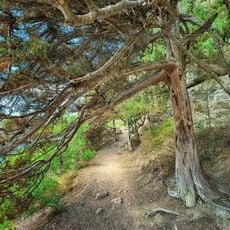
The site is best reached by bus from Sudak to Morske village, followed by approximately thirty minutes of walking along marked trails. Wear sturdy footwear and bring water, as the path involves climbing on slopes and the sun exposure is moderate to strong.
The donjon survives to 8–9 m, about 45% of its original height, and its walls are 1.8 m thick on the sea side but 4.3 m on the landward side. Berthier de la Garde's 1889 survey recorded a dome on the top floor, so the tower never had an open viewing platform.
The community of curious travelers
AroundUs brings together thousands of curated places, local tips, and hidden gems, enriched daily by 94,243 contributors worldwide.