Rossotrudnichestvo's house, Rococo estate in Arbat District, Russia
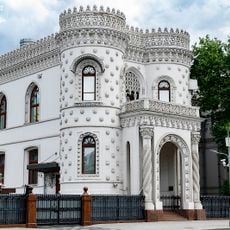
The Shakhovskoy–Krauze–Osipovsky estate at 18/9 Vozdvizhenka Street is a three-storey building with a П-shaped plan. Its main entrance, enclosed by the building, opens from Nizhny Kislovsky Lane. The Vozdvizhenka facade follows the old red line of the street and deviates from its modern alignment. The Rococo facades have semicircular window surrounds, and above the second-floor windows are compositions of flower garlands, shells and volutes.
Prince Yakov Shakhovskoy built the house in 1783; his son Alexey owned it from 1793 to 1842 and rebuilt it in the 1810s–1820s. Doctor I. I. Krauze bought it in 1842, and in 1852 architect N. Ya. Kozlovsky gave the facade its Rococo look, with shops on the ground floor and flats above. Doctor D. T. Osipovsky acquired it in 1868; ennobled in 1878, he had the family coat of arms placed on the pediment. Rossotrudnichestvo occupies it today.
The building now houses Rossotrudnichestvo, the Russian agency for international humanitarian cooperation. Its name links three owners: Prince Yakov Shakhovskoy, who built it in 1783; Dr. Ieronim Krauze, who bought it in 1842; and Dr. Dmitry Osipovsky, owner from 1868, whose coat of arms was placed on the pediment when he received nobility in 1878. From 1900 to 1917 Yelizaveta Varenikova, a relative of the Osipovskys, lived here and became the prototype for characters in several Chekhov stories.
The building stands at 18/9 Vozdvizhenka Street, at the corner with Nizhny Kislovsky Lane, in the Arbat District. The main entrance to the estate, framed by the building itself, is from Nizhny Kislovsky Lane. The Vozdvizhenka facade follows the old red line of the street and therefore deviates from its present alignment. The premises are occupied by Rossotrudnichestvo, so access is limited to the parts open to the public.
Between 1900 and 1917 the house was home to Yelizaveta Varenikova, a relative of the Osipovsky family, who became the prototype for characters in several short stories by Anton Chekhov. The Osipovsky coat of arms, granted in 1878, still sits on the pediment.
The community of curious travelers
AroundUs brings together thousands of curated places, local tips, and hidden gems, enriched daily by 94,056 contributors worldwide.