Historiska museet, Archaeology and cultural history museum in Östermalm, Stockholm, Sweden
The Swedish History Museum is a national museum in Stockholm presenting objects spanning Swedish history from the Stone Age to modern times. The exhibits are organized across different galleries, each focusing on particular periods and themes throughout Swedish history.
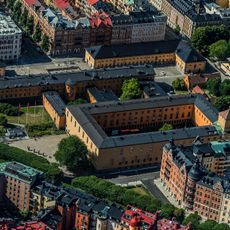
The museum's collections trace back to the 16th-century art collection of King Gustav Vasa at Gripsholm Castle, later enlarged by acquisitions, gifts and spoils of war. After Gustav III's death in 1792 the collections passed to the state, and the Royal Museum opened in Stockholm Palace that same year. The present museum was founded in 1866 by Bror Emil Hildebrand and moved into its current building in 1943.
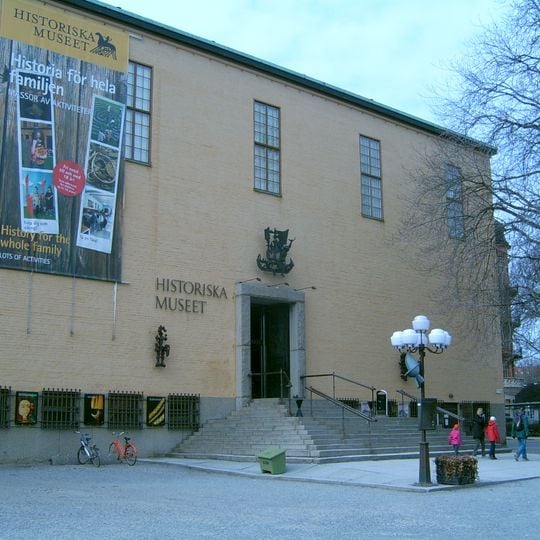
The museum's name appears on the facade and on a banner reading "Historia för hela familjen" (history for the whole family). The bronze entrance doors, called The Gates of History, were made by Bror Marklund after he won a 1938 competition against 42 rivals; they took thirteen years to complete and were inaugurated in 1952. Among the ten relief panels showing Sweden from the Stone Age to the Middle Ages, a standard 1950s pilsner bottle is carved on the far right of the right-hand door.
The museum is easy to reach by public transportation and sits in central Stockholm. Plan to spend two or three hours to see the main galleries and displays.
The Gold Room, opened in 1994 in the basement, was blasted out of the bedrock beneath the courtyard. It holds 3,000 objects, including the three gold collars from the Migration Period: the three-ringed Ålleberg collar, the five-ringed Färjestad collar and the seven-ringed Möne collar, all made around the 5th century.
The community of curious travelers
AroundUs brings together thousands of curated places, local tips, and hidden gems, enriched daily by 94,228 contributors worldwide.