Ullevi, Stadium in Sweden
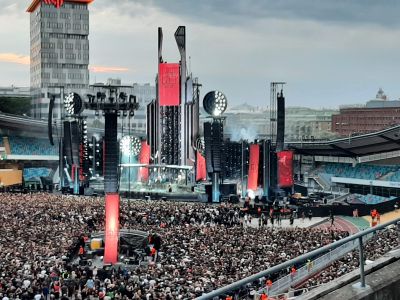
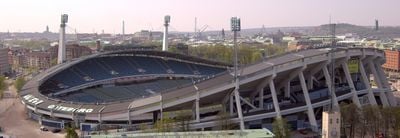
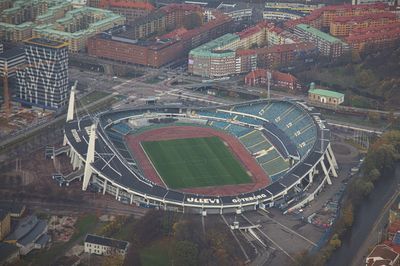
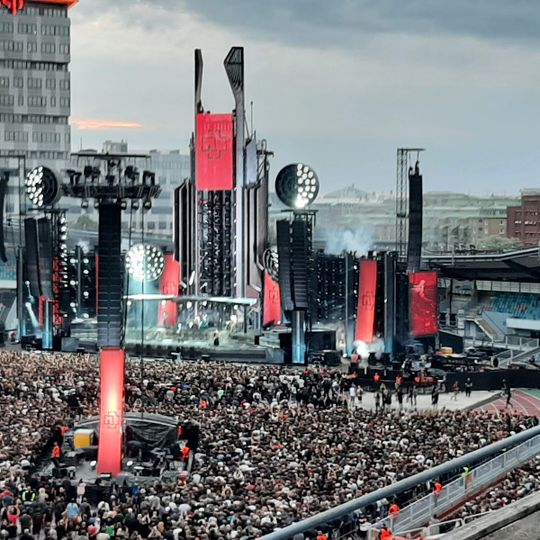
Ullevi is a closed oval stadium in Gothenburg, built 1957–58 to designs by Fritz Jaenecke and Sten Samuelson. Its two 53-metre concrete pylons carry the main stand roof on steel cables, so no supporting columns block the view. The stands are wider and higher along the long sides than at the ends, and the arena holds 43,000 seated, up to 75,000 for concerts.
Gothenburg's city council approved the stadium in 1956 for the 1958 FIFA World Cup, and it opened on 29 May 1958. Architect Fritz Jaenecke of Jaenecke & Samuelson designed it as a closed "sports fortress" with two 53-metre concrete pylons. It hosted the 1992 European Championship final and the 2004 UEFA Cup final.
The name Ullevi means roughly "Ull's property or temple", after Ull, the god of games and play in Norse mythology. Each summer the stadium hosts the opening ceremony of the Gothia Cup, the world's largest youth football tournament by number of participants, and the Världsungdomsspelen athletics meet draws around 3,000 athletes a year.
Ullevi sits in the Heden area of central Gothenburg, a short walk from the Korsvägen and Ullevi södra tram stops. The stands are steepest along the long sides and lower at the ends, so seats on the sides give the clearest view of the pitch. For concerts the pitch is opened up and standing places are sold.
The stadium nearly collapsed during a Bruce Springsteen concert on 8 June 1985, when tens of thousands of spectators moved in rhythm on the clay soil beneath it. The show caused close to £3 million in damage, and David Bowie's June 1987 Glass Spider concert was moved to Eriksberg over safety fears. The concrete pillars were afterwards extended down to the bedrock.
The community of curious travelers
AroundUs brings together thousands of curated places, local tips, and hidden gems, enriched daily by 93,377 contributors worldwide.