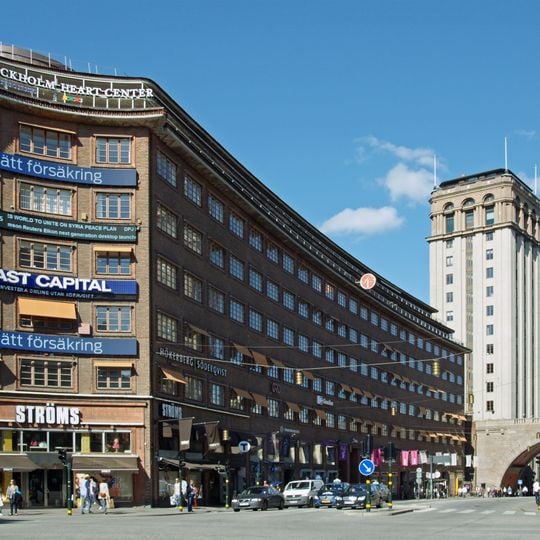
Centrumhuset, Commercial building in Norrmalm district, Stockholm, Sweden
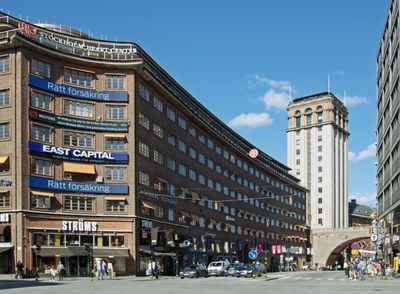
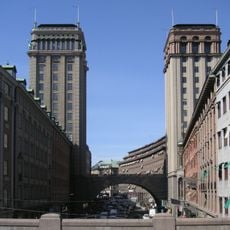
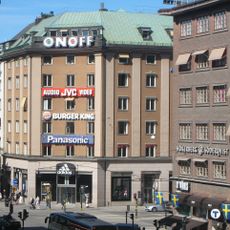
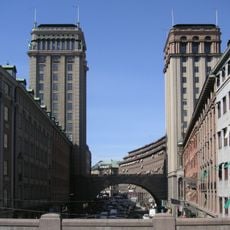
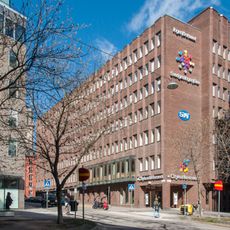
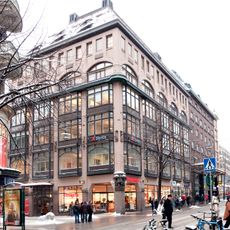
Centrumhuset occupies the block bounded by Kungsgatan, Sveavägen, Apelbergsgatan and Malmskillnadsgatan. Built 1929–31 to Cyrillus Johansson's designs, it has a concave corner at Kungsgatan–Sveavägen, a dark stone ground floor with shopfronts, and upper floors in profiled red-brown brick. The top three storeys are set back and stepped, and the facade has horizontal mullioned windows and a projecting cornice.
Built 1929–31 to Cyrillus Johansson's designs for Hufvudstaden AB, which still owns it; Kreuger & Toll did the foundations and concrete. The iron column frame replaced load-bearing walls, allowing flexible floors: in 1964 Stockholm's property office moved into Sweden's first open-plan office here. Meeths fashion store occupied the building from the 1940s to the 1970s.
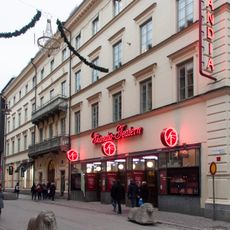
The corner is known as "Ströms hörna" after the Ströms clothing store, which has had its entrance at Kungsgatan–Sveavägen since 1928. In 1962 the store occupied four floors and employed over 200 people, mostly tailors and seamstresses. The building also gave its name to the "Centrum" square in the Swedish edition of Monopoly.
The building sits at a major intersection with direct access to the underground station, making it easy to reach by public transport. Visitors can explore the ground floor for shops and cafes, or simply walk around the exterior to admire the curved facade and architectural details.
The concave corner is nicknamed "Ströms hörna" after the clothing store that has had its entrance there since 1928. In 1962 Ströms occupied four floors, with a large tailoring workshop and over 200 employees, mostly tailors and seamstresses. The corner and its counterpart across the crossing have long been used for illuminated advertising on several window breastwork levels.
The community of curious travelers
AroundUs brings together thousands of curated places, local tips, and hidden gems, enriched daily by 94,434 contributors worldwide.