Trnovo Bridge, Pedestrian bridge in Ljubljana, Slovenia
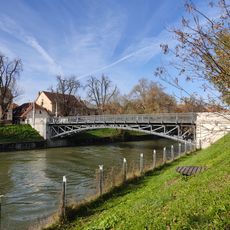
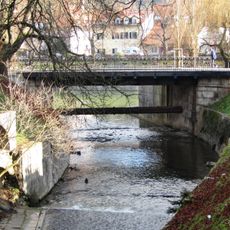
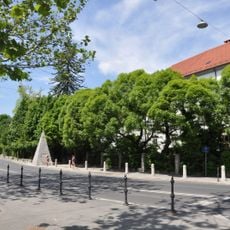
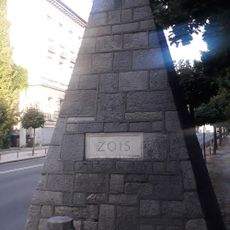
Trnovo Bridge is a 20-metre-wide iron-concrete span over the Gradaščica, supported by a stone arch and clad in rough-cut Podpeč limestone. Its square platform carries two rows of birches between pedestrian and vehicle lanes, four corner pyramids echoing the church spires, a statue of St. John the Baptist by Nikolaj Pirnat, and an obelisk with a lamp dedicated to Sigmund Zois. Stone tablets read Krakovo and Trnovo.
A wooden bridge on this site, recorded by Valvasor in the 17th century, carried the only land route between Trnovo and Krakovo and the walled city. The last wooden span collapsed on 3 May 1875 under a carriage, after which a bridge on stone piers was built. Jože Plečnik's iron-concrete bridge followed in 1929–1932, blessed by parish priest Fran Saleški Finžgar at Pentecost 1932.
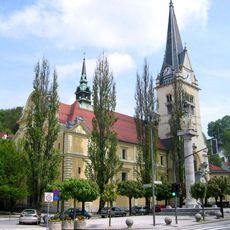
The bridge links two historic neighborhoods and incorporates design elements that echo the nearby Trnovo Church, with pyramidal shapes mirroring the church spires. Visitors encounter religious symbols like a statue of St. John the Baptist on the crossing, reflecting the spiritual character of the surrounding area.
The bridge is readily accessible for both pedestrians and cyclists and can be reached from either riverbank without needing to take a roundabout route. Access is level and direct, making it a straightforward crossing between the two neighborhoods.
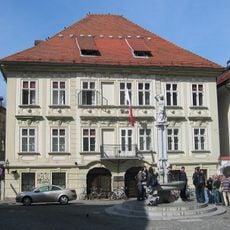
The bridge's four corners carry low pyramids modelled on the spires of Trnovo Church, and a slender obelisk with a lamp faces the statue of St. John the Baptist. The statue, by sculptor Nikolaj Pirnat, and the bridge were blessed by parish priest Fran Saleški Finžgar on Whitsunday 1932.
The community of curious travelers
AroundUs brings together thousands of curated places, local tips, and hidden gems, enriched daily by 94,392 contributors worldwide.