Apsley House, History museum at Hyde Park Corner, London, England
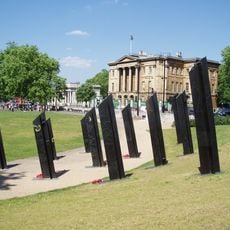
Apsley House is a three-storey neoclassical townhouse of pale Bath stone at Hyde Park Corner, its red-brick core by Robert Adam clad and extended by Benjamin Dean Wyatt. Six Corinthian columns carry a pediment above a rusticated ground floor with three arched openings, and a flagpole rises from the roof.
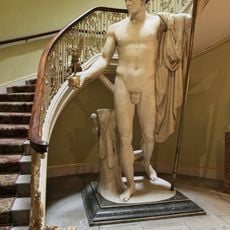
Robert Adam built the house in red brick between 1771 and 1778 for Lord Apsley, the Lord Chancellor, who gave it its name. Richard Wellesley bought it in 1807 and sold it in 1817 to his brother Arthur, the 1st Duke of Wellington. Benjamin Dean Wyatt then added a three-storey north-east extension from 1819, and after 1828 a new staircase and the Waterloo Gallery, cladding the brick in Bath stone and adding the pedimented portico; costs rose from an estimate of £23,000 to over £61,000.
The house is named after Lord Apsley, the Lord Chancellor who commissioned it. Since 1853, when the 2nd Duke opened a Museum Room of his father's gifts and trophies, visitors have seen the Wellington Collection. The Waterloo Banquet is still held each 18 June in the Waterloo Gallery, whose red-hung walls hold Goya's equestrian portrait of the Duke.
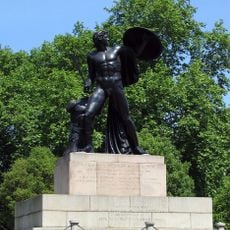
Apsley House stands alone at Hyde Park Corner, its official address 149 Piccadilly; the Wellington Arch and the Duke's equestrian statue face it across the traffic roundabout. The 9th Duke of Wellington keeps a private apartment on the northern half of the ground floor, so those rooms are not open. The museum is run by English Heritage, which took over from the Victoria and Albert Museum in 2004.
The nickname Number One, London, came from toll gates at Knightsbridge: Apsley House was the first great house travellers passed entering the city. Its official address remains 149 Piccadilly, W1J 7NT, though neighbouring houses were demolished to widen Park Lane.
The community of curious travelers
AroundUs brings together thousands of curated places, local tips, and hidden gems, enriched daily by 93,334 contributors worldwide.