Ohio Stadium, American football stadium in Columbus, United States
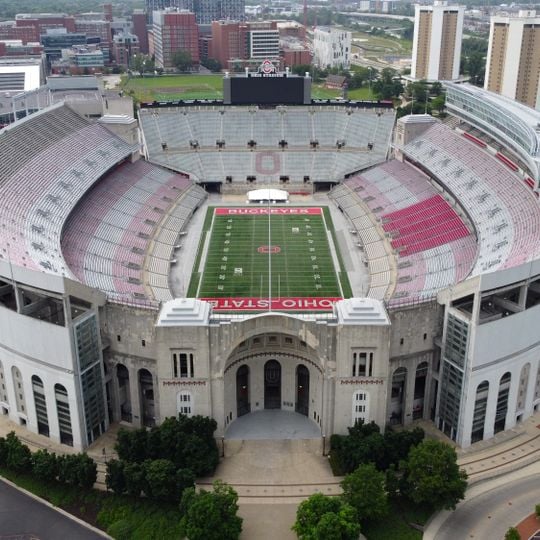
Ohio Stadium is a sports stadium in Ohio, United States, with a horseshoe shape and double rows of columns. The stands seat more than 100,000 spectators spread across three tiers with continuous sightlines to the playing field.
Ohio Stadium opened on October 7, 1922, with a game against Ohio Wesleyan before about 25,000 spectators, and was formally dedicated on October 21 against Michigan. Architect Howard Dwight Smith had conceived the horseshoe plan in 1918, and a public subscription raised over $1.1 million in pledges. Built of poured concrete for $1.34 million, it was then the largest poured-concrete structure in the world. Renovations from 1998 to 2001 removed the running track and lowered the field.
The stadium's horseshoe shape gave it the nickname "The Horseshoe"; it is also called "The Shoe" and "The House That Harley Built." The north rotunda, modeled on the Pantheon in Rome, holds stained-glass murals of the offensive and defensive squads. Each May the stadium hosts the university's Spring Commencement.
On game days the grounds open several hours before kickoff so visitors can find their seats without rushing. Accessible entrances and elevators make it easier for people with limited mobility to navigate.
The north rotunda was modelled on the dome of the Pantheon in Rome and now holds stained-glass murals of the offensive and defensive squads. The stadium rests on the Olentangy River flood plain, so a slurry wall at its base keeps the water out. When it opened in 1922 it was the largest poured concrete structure in the world.
The community of curious travelers
AroundUs brings together thousands of curated places, local tips, and hidden gems, enriched daily by 93,359 contributors worldwide.